
Table of Contents
The way people search for information online has changed significantly in recent years. Traditional search engines usually depend on words, names, websites, and other text-based information. FaceCheck ID introduces a different approach by allowing users to search the public web using a face image rather than a traditional keyword. This makes face search useful for understanding where a publicly available image may appear online, checking possible image reuse, and researching visual matches.
FaceCheck ID is designed as a face-search engine rather than a conventional reverse image search service. According to its own documentation, the system focuses on facial features and searches indexed public web pages for images that contain visually similar faces. This distinction is important because a traditional reverse image search may primarily look for the same or closely related image, while face search can potentially find different photographs of a similar face.
However, FaceCheck ID should not be treated as an automatic identity-verification system that proves who a person is. A search result represents a visual similarity or a possible match, not guaranteed proof of identity. The surrounding page, source, date, username, context, and other independent information should always be reviewed before reaching a conclusion. FaceCheck ID itself explains that its results should be treated as leads rather than definitive identification.
What Is FaceCheck ID?
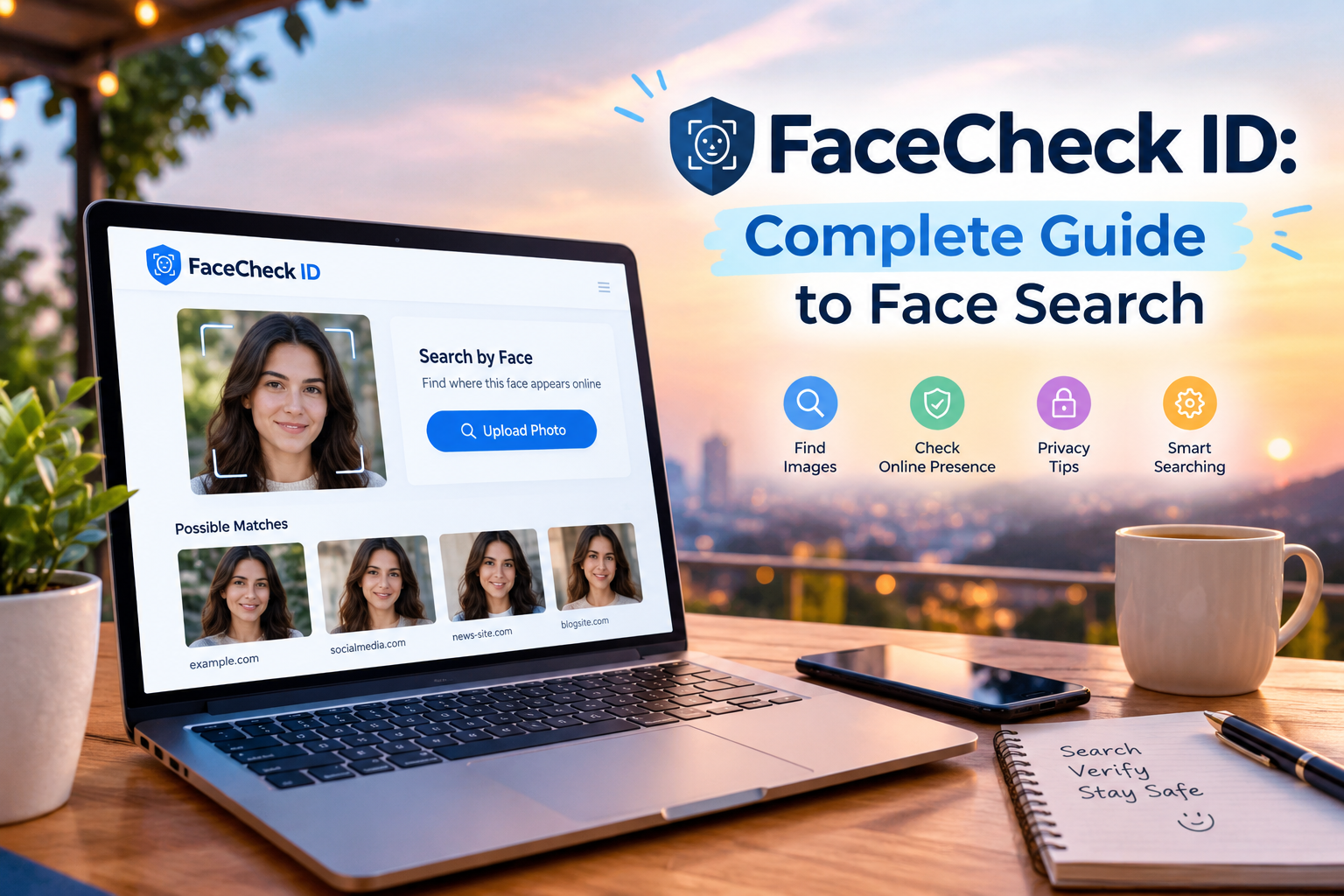
FaceCheck ID is an online face-search service that allows a user to submit a photograph containing a face and search for related appearances across publicly accessible web pages. Instead of depending primarily on a person’s name or username, FaceCheck ID uses facial characteristics as the starting point of the search.

The basic idea behind FaceCheck ID is straightforward. A user provides a suitable image, the system detects the face, analyzes visual characteristics, and compares those characteristics with faces contained in its indexed collection. The service then presents potential matches and links to pages where similar faces have appeared.
This approach can be particularly interesting when someone has an image but does not know the exact source of that image. For example, an image may have been reposted on multiple websites, used as a profile picture, or included in a public article. A conventional image search may struggle when the photograph has been cropped, edited, filtered, or placed inside a different composition. Face-based searching approaches the problem from the facial features rather than simply searching for identical pixels.
It is important to understand the distinction between face search and identity confirmation. FaceCheck ID can help locate pages containing visually similar faces, but finding a similar face does not automatically establish a person’s legal name, occupation, location, age, or other personal information. The service itself states that it does not function as a personal-data search engine and warns users not to treat facial-search results as definitive identity evidence.
How FaceCheck ID Works
The technology behind FaceCheck ID involves analyzing the visual characteristics of a face rather than simply comparing the complete uploaded photograph. Its published explanation describes a process in which facial features are converted into a numerical representation, commonly referred to as an embedding, and then compared with representations generated from indexed images.
When an image is submitted, the system first needs to locate a face within that image. The quality of this step can influence the quality of the final results. A clear photograph where the face is visible generally provides more useful information than an image where the face is extremely small, blurred, heavily obstructed, or viewed from an unusual angle.
After the face is detected, the system analyzes its visual characteristics. These can include relationships among facial features and other patterns that allow the system to compare one face with another. The resulting numerical representation can then be compared with facial representations associated with images in the service’s searchable index.
The system does not need the uploaded image to be an exact duplicate of another photograph. This is one of the major differences between face search and ordinary reverse image search. Two photographs can have different backgrounds, lighting, clothing, cropping, or compositions while still containing visually similar facial features.
The results are then presented as possible matches. Users should understand that a match score or similarity signal is not equivalent to a confirmed identity. A high similarity result can still be incorrect, especially when people have similar facial characteristics. FaceCheck ID specifically notes that identical twins, relatives, lookalikes, edited images, and other unusual cases can create false positives.
FaceCheck ID vs Traditional Reverse Image Search
FaceCheck ID is often discussed alongside reverse image search tools, but the two approaches are not exactly the same.
A traditional reverse image search generally attempts to discover copies, near-duplicates, or visually related versions of an image. If the same photograph has been published on several websites, the search engine may be able to connect those pages.
FaceCheck ID takes a different approach by focusing on the face inside the image. This means that the original photograph does not necessarily have to be reused exactly. A different photograph containing a similar face may also appear in the results.
For example, imagine that an original portrait has been cropped before being uploaded to another website. A conventional image search may have difficulty connecting the cropped version to the original. Face search can potentially focus on the face itself rather than the complete composition.
This does not mean that FaceCheck ID will always find more information. Its results depend on what has been publicly indexed and on the quality of the submitted image. Private profiles, deleted content, pages inaccessible to crawlers, and photographs that have never been publicly indexed may not appear.
Therefore, FaceCheck ID and traditional reverse image search can be viewed as different approaches to visual research rather than exact replacements for one another.
How to Use FaceCheck ID
Using FaceCheck ID generally begins with selecting an appropriate photograph. A clear image with a visible face is normally more useful than a photograph where the face is hidden or heavily distorted.
Once a suitable image is available, the user can submit it through the service’s face-search interface. The system processes the image and returns possible matches associated with publicly indexed web pages.
The results should then be reviewed carefully. Instead of immediately assuming that the first result represents the same individual, users should examine the page where the image was found. Look at the surrounding text, publication date, username, profile information, and other contextual details.
A useful way to approach FaceCheck ID is to consider every result as a research lead. If several independent pages contain related photographs and the surrounding information is consistent, the evidence may become more useful. On the other hand, a single isolated result with little supporting information should be treated cautiously.
The official FaceCheck ID website provides additional information about its face-search technology, privacy practices, and limitations. FaceCheck ID official website
What Makes a Good FaceCheck ID Search Image?
Image quality can have a significant effect on face-search results. A photograph with a clearly visible face generally gives a facial-search system more information to work with.
A front-facing image can be useful because important facial features are easier to detect. Good lighting can also help because excessive darkness, strong shadows, or extreme highlights can make facial characteristics harder to analyze.
Very small faces may produce weaker results because fewer facial details are available. Similarly, motion blur, heavy compression, extreme filters, sunglasses, masks, or unusual camera angles can make the search more difficult.
FaceCheck ID’s published information explains that front-facing, well-lit images with visible facial features generally provide stronger search conditions, while heavy filters, blur, sunglasses, masks, and extreme angles can reduce result quality.
For this reason, selecting the right photograph is one of the most important steps in a FaceCheck ID search. Uploading several suitable photographs can also help a user understand whether a result is consistently appearing or was produced by an unusual image.
Understanding FaceCheck ID Results
One of the most important parts of using FaceCheck ID is understanding what the results actually mean.
A result does not automatically mean that the person shown on the matched page is the person in the uploaded photograph. Instead, it means that the system detected a facial similarity strong enough to include that page among its candidates.
This distinction matters because facial similarity exists between unrelated people. Relatives can share certain features, and unrelated individuals can also look remarkably similar. Facial-search algorithms may therefore produce both useful matches and false positives.
The context of the result is extremely important. Suppose a face appears on several unrelated public websites alongside consistent information. That pattern can provide stronger evidence than a single result from an unknown page. FaceCheck ID’s own documentation recommends considering multiple independent appearances and contextual information rather than relying exclusively on a similarity score.
Users should also remember that a web page may contain outdated information. A photograph from several years ago does not necessarily describe a person’s current circumstances. Similarly, an image can be reused by somebody who is not the person depicted in it.
Can FaceCheck ID Confirm Someone’s Identity?
FaceCheck ID should not be treated as definitive identity verification.
The service describes itself as a face-search engine that finds websites containing images resembling the submitted face. It specifically explains that it does not identify people in the sense of providing confirmed personal identity information.
This limitation is especially important when the consequences of an incorrect conclusion could be serious. A facial similarity result should not be used by itself to accuse somebody of wrongdoing, establish legal identity, make employment decisions, or make other high-stakes judgments.
Instead, the result can be considered one piece of information that may require independent verification.
A responsible approach is to compare information from multiple trustworthy sources and avoid treating an algorithmic match as a final answer.
FaceCheck ID and Online Scam Awareness
One possible use of face search is checking whether a publicly available profile photograph appears elsewhere online. This can sometimes be useful when evaluating suspicious online interactions.
For example, a person may encounter a profile that uses a photograph that appears unusually polished or inconsistent with the surrounding information. A face-search tool may help determine whether similar photographs appear on other public websites.
However, even this use requires caution. Finding the same photograph elsewhere does not automatically prove that the person communicating through an account is a scammer. Photographs can be legitimately reused, reposted, licensed, or shared by multiple people.
Likewise, a face-search result cannot establish someone’s intentions. It can provide information that deserves further examination, but the user should evaluate the broader context.
FaceCheck ID describes applications involving stolen profile photographs, impersonation, and online fraud research, while also emphasizing that results should be treated as leads rather than conclusive evidence. https://newsunfold.com/rcb-ka-baap-kaun-hai/
Read more about: rcb ka baap kaun hai
FaceCheck ID for Finding Your Own Images
Another important use of FaceCheck ID is monitoring where your own publicly available photographs may appear online.
People sometimes discover that their profile photographs have been reused on websites or accounts they do not recognize. A face-search engine can potentially help locate public appearances of a face that may otherwise be difficult to find through text searches.
This can be particularly useful for people who publish photographs publicly and want to understand their online image footprint.
If you discover an unauthorized use of your photograph, the appropriate response depends on the website, jurisdiction, and circumstances. You may be able to contact the website operator, request removal, or use an applicable copyright or privacy process.
FaceCheck ID also provides information about removing images from its searchable system and states that users can request removal of their own photographs.
FaceCheck ID Privacy Considerations
Privacy is one of the most important topics surrounding any face-search technology.
According to FaceCheck ID’s published FAQ, uploaded search images are not added to its searchable database. The service states that searches are temporarily retained and that search history is deleted within 24 hours. It also states that it does not log users’ IP addresses and that uploaded photographs are deleted rather than indexed as new searchable images.
The service also explains that its searchable database contains low-resolution facial thumbnails and links to publicly available websites rather than original source photographs.
Users should still read the current privacy information of any face-search service before uploading a photograph. Privacy policies can change, and laws governing facial information differ between countries and regions.
It is also wise to avoid uploading photographs unnecessarily. Before submitting an image, users should understand why they are searching, what information they expect to learn, and how they will handle the results.
Ethical Use of FaceCheck ID
Face search raises ethical questions because a photograph that is publicly visible is not necessarily something the person expected to become searchable by facial characteristics.
A public photograph may have originally been shared for a specific purpose. Turning that photograph into a searchable facial reference can create additional privacy implications.
FaceCheck ID itself discusses concerns related to consent, accuracy, false positives, and responsible use of facial-search technology.
Responsible use means avoiding harassment, stalking, intimidation, doxxing, or attempts to expose private information. It also means remembering that the presence of someone’s face on a website does not automatically reveal who controls the account or what the person intended.
A useful principle is to treat face-search results as information requiring context rather than as permission to investigate every aspect of another person’s private life.
FaceCheck ID and False Positives
False positives are among the biggest limitations of facial search.
A false positive occurs when the system returns a visually similar face that belongs to a different person. This can happen because unrelated people can share facial characteristics. Similar lighting, facial angles, image quality, and other visual factors can also affect algorithmic comparisons.
Identical twins and close relatives can present especially difficult cases. Edited photographs, AI-generated images, filters, and unusual portraits can also produce confusing results.
For this reason, a high similarity score should not be interpreted as absolute proof. FaceCheck ID explains that a match becomes more meaningful when it is supported by additional contextual evidence, including multiple appearances, consistent information, and reliable source pages.
This is an important lesson for anyone researching images online: similarity is not the same as certainty.
Why FaceCheck ID May Not Find a Result
A search with no results does not necessarily mean that a photograph has never appeared online.
FaceCheck ID depends on publicly accessible content that has been crawled and indexed. If a profile is private, a page has been deleted, an image is behind a login, or a photograph has never been indexed, the search may not find it.
Image quality can also influence the outcome. A low-resolution photograph, an obstructed face, extreme angle, or strong visual filter may prevent the system from producing useful matches.
The web itself is constantly changing. New pages are published, old pages disappear, websites change their structures, and search indexes are updated. Consequently, results can change over time even when the same photograph is used.
FaceCheck ID explains that a clean search result should not be interpreted as proof that a person has no online presence. It only indicates that the searchable index did not return a suitable result for that particular query.
FaceCheck ID for Image Research
Beyond personal searches, face-search technology can be useful as part of broader visual research.
Researchers, journalists, website owners, and individuals investigating image reuse may use face-based searching to discover connections between publicly available photographs. The technology can help narrow a large amount of online information into a smaller set of potentially relevant pages.
However, responsible research requires source verification. If an important claim depends on a FaceCheck ID result, the original webpage should be opened and reviewed directly.
The date of publication should also be considered. An old photograph may have been reused many times, and the website containing it may not represent the original source.
The strongest approach is therefore not to rely on FaceCheck ID alone but to combine visual search with ordinary web research, source checking, dates, usernames, and other publicly available context.
FaceCheck ID and Public Information
FaceCheck ID focuses on publicly accessible web content. This is an important limitation because the public web represents only a portion of all online information.
Private social-media accounts, restricted communities, deleted pages, closed databases, and content that search engines cannot crawl may not appear in results.
This means that FaceCheck ID cannot provide a complete picture of a person’s online activity. A result is limited by the information available to the search system.
Users should also avoid assuming that information attached to a photograph is necessarily accurate. A website can contain incorrect names, outdated descriptions, reposted material, or misleading profiles.
The safest approach is to distinguish between what the photograph shows, what the webpage claims, and what independent sources actually confirm.
Is FaceCheck ID Accurate?
The accuracy of FaceCheck ID depends on several factors, including the quality of the submitted image, the visibility of the face, the characteristics of the photographs in the index, and the amount of publicly available information.
There is no single accuracy percentage that can guarantee a correct answer for every search. Different photographs and situations produce different results.
A clear front-facing photograph can provide stronger facial information than a dark or heavily edited selfie. A person with many public photographs may generate more potential results than someone with a very limited public web presence.
Even when a result looks convincing, users should verify it through independent context. This is particularly important when the result could affect another person’s reputation, privacy, or safety.
Benefits of FaceCheck ID
One of the main benefits of FaceCheck ID is that it allows users to begin a search with a face rather than a name.
Another benefit is that face-based searching can potentially discover different photographs of a similar face even when the images are not exact duplicates.
FaceCheck ID can also be useful for discovering unauthorized reuse of personal photographs and for researching publicly available image appearances.
Its visual approach can complement traditional search engines and reverse image tools. Instead of relying on one method, users can use multiple forms of search to understand where an image may have appeared.
At the same time, these benefits should always be balanced with privacy, accuracy, and ethical considerations.
Limitations of FaceCheck ID
FaceCheck ID has several limitations that users should understand before relying on its results.
The first limitation is that a visual match does not guarantee identity. The second is that the service cannot search information that is unavailable to its public index.
Another limitation is that image quality can influence results. Poor lighting, blur, extreme angles, filters, masks, and other obstructions may reduce the usefulness of a search.
There is also a risk of false positives. A visually similar person can appear in search results even when the individuals are not the same.
Finally, online information can be outdated or misleading. A face appearing on a website does not automatically establish that the account belongs to that person or that the information on the page is correct.
These limitations do not make face search useless. Instead, they demonstrate why FaceCheck ID should be treated as a research tool rather than an unquestionable authority.
Safe and Responsible FaceCheck ID Searching
Responsible use begins with having a legitimate reason for performing a search. Searching your own photographs, investigating possible unauthorized use of your images, or checking publicly available information can be reasonable purposes.
Users should avoid using face-search technology to harass people or expose private information. They should also avoid making serious accusations based solely on an algorithmic match.
Another important practice is to minimize unnecessary data sharing. Only use photographs that are appropriate for the search and understand the service’s current privacy terms before uploading them.
When a search produces an interesting result, verify the source independently. Check the original page, publication date, context, and other information rather than relying only on the FaceCheck ID result page.
FaceCheck ID for Digital Awareness
The growing availability of face-search technology highlights the importance of digital awareness. Photographs posted online can travel far beyond their original context.
A profile picture uploaded to one website may eventually appear on another website, blog, forum, or public page. People who understand how visual search works can better monitor their public digital footprint.
For website owners and content creators, it is also useful to understand how photographs may be discovered through visual search. Proper image management, clear permissions, and responsible publication practices can help reduce unnecessary privacy problems.
For ordinary internet users, the most important lesson is simple: online photographs should be treated as potentially searchable public content when they are posted on publicly accessible websites.
Frequently Asked Questions About FaceCheck ID
What is FaceCheck ID used for?
FaceCheck ID is used for searching publicly indexed web pages for images containing faces that are visually similar to a submitted photograph. It can be useful for image research, finding possible image reuse, and exploring public web appearances.
Does FaceCheck ID guarantee someone’s identity?
No. A facial similarity result should not be considered definitive proof of identity. FaceCheck ID explains that its system finds visually similar faces and that users should verify results using additional context.
Does FaceCheck ID search private social-media profiles?
The service depends on publicly accessible and indexed web content. Private profiles and content that cannot be crawled generally cannot be discovered through its public search index.
Can FaceCheck ID find different photographs of the same person?
Face search is specifically designed to compare facial features rather than only looking for identical photographs. Therefore, different images containing a similar face can potentially appear in results.
Why can FaceCheck ID produce incorrect matches?
Facial similarity does not always mean two photographs show the same individual. Lookalikes, relatives, twins, poor image quality, editing, unusual angles, and other factors can contribute to false positives.
Does FaceCheck ID store uploaded images?
According to FaceCheck ID’s published FAQ, uploaded search images are not added to its searchable database, and searches are temporarily retained before deletion. The service states that search history is deleted within 24 hours.
Can FaceCheck ID help find unauthorized use of my photograph?
It can potentially help locate publicly indexed pages where a similar face appears. This can make it useful for investigating possible image reuse or impersonation, although every result should be checked manually.
What type of photograph works best?
A clear, reasonably well-lit photograph with a visible face is generally more suitable. Strong blur, heavy filters, masks, sunglasses, and extreme angles can make facial searching more difficult.
Is FaceCheck ID the same as Face ID on a smartphone?
No. FaceCheck ID is a web-based face-search service, while smartphone Face ID systems are designed primarily for device authentication. They serve different purposes.
Final Thoughts on FaceCheck ID
FaceCheck ID represents an interesting development in online visual search because it allows a face to become the starting point for discovering publicly indexed web pages. Instead of searching only through names, keywords, or exact image copies, the technology analyzes facial characteristics and looks for visually similar appearances.
Its usefulness comes from the ability to search beyond exact image duplicates. A face may appear in different photographs, on different websites, or in different visual contexts, and face search can potentially connect some of those appearances.
At the same time, FaceCheck ID should be used with realistic expectations. A search result is not automatically an identity confirmation. False positives are possible, public web indexes are incomplete, and information on third-party websites may be inaccurate or outdated.
For the best results, use a clear photograph, examine multiple results, open the original source pages, check dates and context, and verify important information independently. Privacy and ethical considerations should remain part of every face-search decision.
Ultimately, FaceCheck ID is best understood as a visual research tool rather than an unquestionable identity authority. When used responsibly, it can help users explore where faces appear across the public web, investigate possible image reuse, and better understand their own online visual footprint while recognizing the technology’s limitations.