
Table of Contents
The gaming industry has changed dramatically with the growth of web technology, mobile applications, cloud platforms, and interactive digital experiences. Developers and businesses are constantly searching for tools that can make game development, integration, publishing, and management easier. Embedtree Game Software has attracted attention in this area because of its focus on simplifying gaming experiences and helping developers integrate interactive content into digital platforms.For developers, the biggest challenge is often not having a game idea but turning that idea into a functional and accessible product. Modern game development can involve programming, graphics, sound, testing, optimization, hosting, analytics, and distribution. A suitable game software solution can reduce some of this complexity and help teams concentrate more on creativity and user experience.
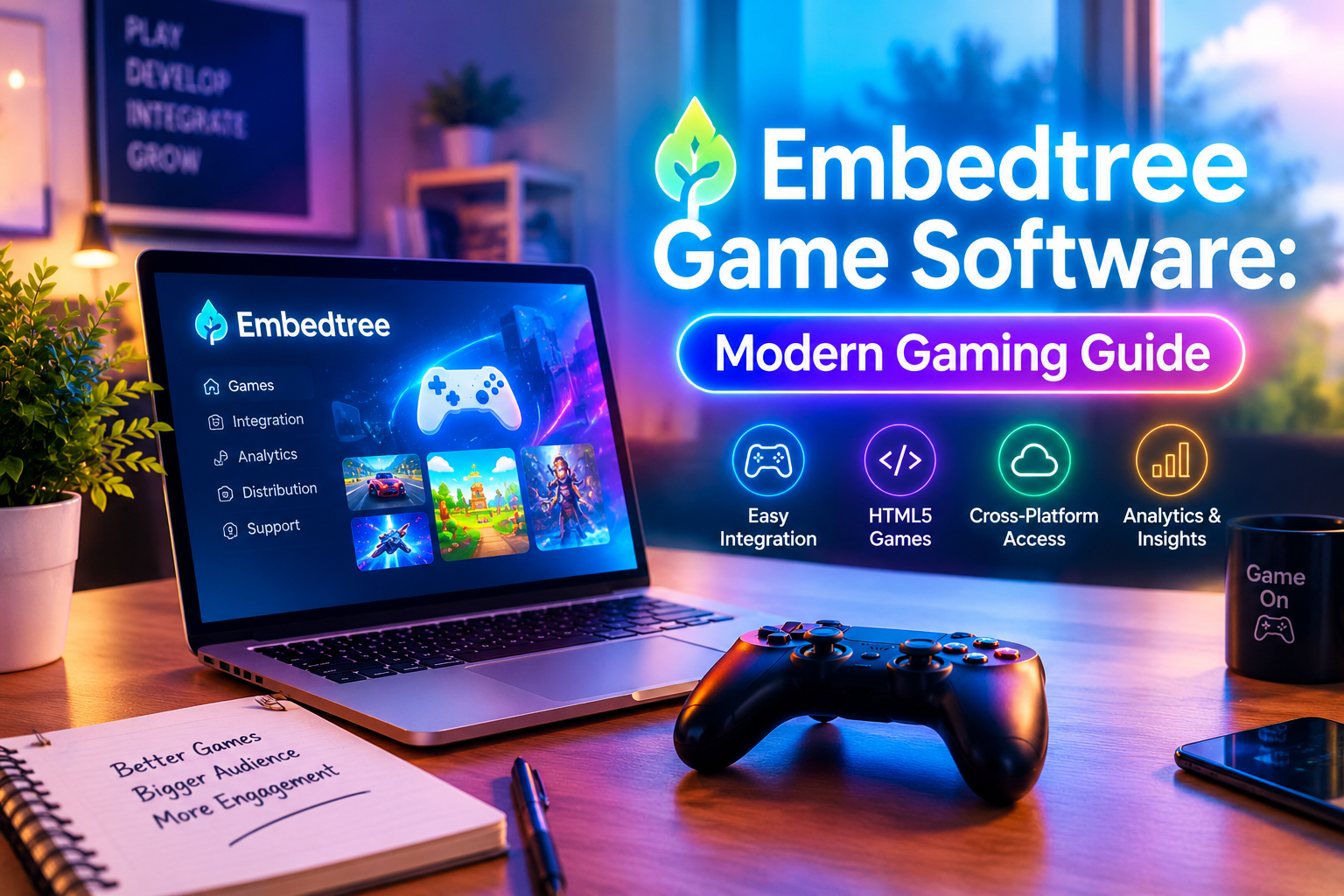
Embedtree Game Software is generally discussed as a platform and toolset associated with game development, game integration, distribution, and interactive gaming experiences. Existing information about Embedtree describes features such as easier integration, game libraries, customization, analytics, responsive experiences, and support for distributing HTML5 games.This guide explains the concept behind Embedtree Game Software, its potential features, benefits, use cases, integration considerations, and the factors developers should evaluate before using any gaming platform.
What Is Embedtree Game Software?
Embedtree Game Software can be understood as a gaming-focused solution designed to make interactive games easier to integrate into websites, applications, and other digital environments. Instead of requiring every project to build its entire gaming infrastructure from scratch, an embedding-oriented approach can help developers deliver games through existing digital platforms.
The concept is particularly useful for HTML5 games because browser-based gaming can be distributed across websites without requiring users to install traditional desktop software. Embedtree-related material describes the platform as a way to host, distribute, and monetize HTML5 games while reducing some of the technical work involved in game delivery.The exact capabilities available to a developer can depend on the implementation, project requirements, and current platform functionality. Therefore, developers should always verify current documentation and available features before selecting a platform for production use.

Why Is Embedtree Game Software Important?
Modern players expect games to load quickly, work across different devices, and provide a smooth experience. At the same time, developers want efficient workflows that reduce unnecessary development time.This is where Embedtree Game Software can become relevant.A gaming integration platform can provide a bridge between game content and the website or application where that content is presented. Instead of sending users away from a website to another gaming environment, developers can potentially place interactive experiences directly inside their digital products.
This approach can be valuable for gaming websites, educational platforms, entertainment portals, content publishers, community websites, and businesses that want to increase user engagement.The broader idea is simple: make games easier to deliver while creating a more connected experience between the game and the platform hosting it.
Key Features of Embedtree Game Software
One of the reasons developers explore Embedtree Game Software is the range of capabilities associated with game integration and distribution. While individual implementations can vary, several important features are commonly discussed.
Easy Game Integration
One of the major advantages of an embedding-based gaming platform is simplified integration.Developers can potentially add interactive games to an existing website or application without rebuilding the entire project around gaming functionality. This can save development time and make gaming content easier to manage.For websites that already have an established audience, integrated games can become an additional form of content rather than a completely separate product.
HTML5 Game Support
HTML5 has become an important technology for browser-based games because it allows interactive content to run directly through modern web browsers.Embedtree-related resources specifically discuss hosting and distributing HTML5 games.HTML5 gaming can be particularly useful for casual games, puzzle games, educational experiences, arcade-style titles, and lightweight multiplayer projects. Players can access these experiences without necessarily installing a traditional desktop application.Developers interested in browser gaming can also learn more about modern web game technologies through the official MDN Web Docs resources.
Cross-Platform Accessibility
A major goal of modern game development is reaching players on different devices.A browser-based approach can help developers target desktop computers, laptops, tablets, and smartphones through compatible web browsers. This reduces the need to create completely different experiences for every operating system.However, responsive design and device optimization remain important. A game that works well on a desktop may require different controls, screen layouts, and performance settings on a smartphone.
Customization
Customization is another important part of gaming software.Developers often want their games to match the visual identity of their websites or applications. This may involve adjusting layouts, backgrounds, buttons, game containers, loading screens, or surrounding content.Customization can make an embedded gaming experience feel like a natural part of the host platform instead of an unrelated third-party component.
Analytics and Performance Monitoring
Analytics can help developers understand how players interact with games.
Useful metrics may include game sessions, player activity, loading performance, engagement levels, returning visitors, and other relevant measurements.
These insights can help developers identify which games attract users and where players may be leaving.
For businesses, analytics can be especially important because simply adding a game is not enough. The real value comes from understanding whether that game improves engagement or contributes to broader business objectives.
Read more about: slides.go
Game Distribution
Game distribution is another major consideration.
Developers may want to publish a game across multiple websites, applications, partner platforms, or digital channels. A centralized approach can make updates and content management easier.
Embedtree-related material describes distribution capabilities that can help developers deliver games across partner sites and digital channels.
Benefits of Using Embedtree Game Software
The potential benefits of Embedtree Game Software extend beyond simply adding games to a webpage.
Faster Development Workflow
A ready-made integration environment can reduce the amount of infrastructure developers need to build themselves.
Instead of spending excessive time creating basic delivery systems, teams can concentrate on gameplay, design, content, and user experience.
This can be especially helpful for smaller teams that have limited development resources.
Better User Engagement
Interactive content can encourage visitors to spend more time on a website or application.
A website that provides articles, videos, tools, and games may offer users more reasons to explore different sections.
Games can also encourage repeat visits when users have scores, achievements, challenges, or progress to continue.
Easier Content Expansion
Adding gaming content can expand the type of experiences available on a website.
For example, an educational website could provide learning games, while a community website could offer casual entertainment. A media platform could use interactive games as an additional content format.
Potential Monetization
Gaming can also create monetization opportunities.
Depending on the platform and business model, developers may explore advertising, premium access, subscriptions, sponsorships, licensing, or in-game purchases.
Embedtree-related documentation discusses monetization through advertising, purchases, and licensing models.
However, monetization should always be designed around the target audience. Excessive advertising can damage user experience and reduce player retention.
How Embedtree Game Software Can Be Used
There are many potential applications for gaming integration.
Gaming Websites
Gaming websites can use embedded games to create large collections of browser-based entertainment.
Instead of requiring visitors to download individual applications, websites can organize games into categories and allow users to play directly through their browsers.
Educational Platforms
Educational games are becoming increasingly popular because interactive activities can make learning more engaging.
A school, training platform, or educational publisher could potentially integrate games related to mathematics, language learning, science, memory, or problem-solving.
Business Websites
Businesses can also use games as engagement tools.
For example, a brand could create a simple interactive experience connected to a marketing campaign. Visitors might complete challenges, answer questions, or participate in branded activities.
Mobile-Friendly Websites
Browser-based gaming can be particularly useful for websites that receive substantial mobile traffic.
However, developers should optimize touch controls, screen dimensions, loading time, and resource usage to provide a smooth mobile experience.
How to Get Started With Embedtree Game Software
The setup process depends on the specific implementation, but a general workflow can be organized into several stages.
Choose the Game
Start by identifying the type of game you want to integrate.
Consider the target audience, genre, device requirements, average session length, and technical requirements.
Prepare the Game Build
The game should be properly optimized before deployment.
For HTML5 games, developers should pay attention to JavaScript files, graphics, audio, fonts, animations, and other resources.
Large assets can increase loading times, so compression and optimization are important.
Configure the Integration
Once the game is prepared, developers can configure the relevant integration method.
This may involve an embed code, script, API, content-management integration, or another technical method depending on the platform.
Test Across Devices
Testing should not be skipped.
A game should be checked on desktop computers, smartphones, and tablets where applicable. Developers should also test different browsers and screen sizes.
Important areas to evaluate include loading speed, controls, visual layout, sound, gameplay responsiveness, and error handling.
Launch and Monitor
After testing, the game can be published.
Once users begin interacting with it, analytics and feedback can help identify areas that require improvement.
Game performance should be monitored continuously rather than only during the initial launch.
SEO and Embedtree Game Software
SEO is another important consideration for websites that publish browser games.
Search engines need useful context to understand the page. Simply embedding a game may not provide enough textual information for a search engine to understand its purpose.
Developers can improve the surrounding page by adding a descriptive title, relevant headings, introductory content, instructions, FAQs, and useful information about the game.
The target keyword should be used naturally rather than repeated excessively.
For example, a page about Embedtree Game Software can discuss game integration, browser gaming, HTML5 games, game distribution, game development tools, interactive content, gaming platforms, performance optimization, and player engagement.
This creates semantic relevance without relying on repetitive keyword usage.
Performance Optimization
Performance is one of the most important factors in browser gaming.
Players generally expect games to load quickly and respond immediately. Heavy files, unoptimized images, excessive scripts, and poor hosting can create delays.
Developers should consider compressing assets, reducing unnecessary JavaScript, optimizing images, using caching, and delivering resources efficiently.
Embedtree-related guidance also highlights techniques such as compressed assets, minified code, file splitting, and CDN-based delivery as ways to improve game performance.
Performance optimization is not only about speed. It can also influence user satisfaction, engagement, and retention.
Security Considerations
Security should be considered whenever external games, scripts, APIs, or third-party services are integrated into a website.
Developers should verify the source of game files and integrations. They should also keep dependencies updated and use appropriate security policies.
Sensitive information should not be exposed through client-side game code.
Web applications should also validate external inputs and carefully manage permissions.
These practices help reduce the possibility of security vulnerabilities affecting the host website.
Embedtree Game Software for Developers
For developers, the main attraction of Embedtree Game Software is the possibility of simplifying parts of the game delivery process.
A development team can focus on gameplay mechanics, visual design, sound, player progression, and content while using supporting infrastructure for distribution and integration.
This can be especially valuable for indie developers and small studios.
Large teams may also find value in centralized distribution, version management, analytics, and deployment workflows.
The right choice ultimately depends on the project’s technical requirements and the features currently supported by the platform.
Embedtree Game Software for Businesses
Businesses are increasingly using interactive content to improve digital engagement.
A game can turn a static webpage into an interactive experience. This can be useful for promotional campaigns, product launches, educational content, loyalty programs, and branded experiences.
For example, a company could create a short challenge related to a new product. Users could participate, receive rewards, and share their results.
This creates an experience that can be more memorable than conventional advertising.
However, businesses should ensure that the game provides genuine value rather than functioning only as an interruption.
Common Challenges
Although game integration can offer many advantages, developers should also consider potential challenges.
Performance can become an issue when games contain large assets or complex mechanics.
Compatibility may also vary across browsers and devices.
Another challenge is maintenance. Games require updates, bug fixes, security checks, and compatibility testing.
Monetization can create another balancing problem. Advertising may generate revenue, but too many ads can negatively affect the player experience.
Developers should therefore evaluate both technical requirements and user expectations before launching a large-scale gaming project.
Best Practices for Embedtree Game Software
A successful implementation starts with a clear objective.
Before integrating a game, decide whether the primary goal is entertainment, education, engagement, marketing, monetization, or another purpose.
Keep the interface simple and make the game easy to access.
Optimize resources before publishing.
Test the game across multiple devices and browsers.
Use analytics to understand player behavior.
Keep the software and dependencies updated.
Make the surrounding webpage useful and informative for both users and search engines.
Finally, collect feedback and improve the experience over time.
The Future of Game Integration
embedtree game software future of gaming is moving toward increasingly connected experiences.
Cloud technology, artificial intelligence, browser-based applications, real-time multiplayer systems, virtual reality, augmented reality, and advanced analytics are influencing how games are created and delivered.
Game development is also becoming more accessible. Tools that simplify technical workflows can allow smaller teams and independent developers to experiment with new ideas.
In this environment, platforms focused on game integration and distribution can become useful components of a broader digital strategy.
Embedtree Game Software fits into this wider movement by focusing on making gaming experiences easier to integrate, distribute, and manage.
Is Embedtree Game Software Worth Considering?
Whether Embedtree Game Software is suitable depends on the project’s requirements.
It may be worth considering when a developer needs browser-based game distribution, embedded gaming experiences, easier integration, or a way to connect interactive content with an existing website or application.
Developers should compare current features, documentation, pricing, supported technologies, security practices, analytics capabilities, and scalability before making a final decision.
No single game software platform is perfect for every project. The best solution is the one that matches the technical needs, budget, audience, and long-term goals of the project.
Conclusion
Embedtree Game Software represents an interesting approach to modern game development, integration, and distribution. Its focus on embedded games, HTML5 delivery, customization, analytics, and accessibility can make it relevant for developers, publishers, businesses, and content platforms.
The most important factor is not simply choosing a gaming tool but using it strategically. With optimized games, responsive design, strong performance, useful analytics, and a good user experience, embedded gaming can become a valuable part of a modern digital platform.In short, Embedtree Game Software can be considered when the goal is to bring interactive gaming experiences closer to websites, applications, and online audiences.