
Table of Contents
Host Gimkit is a popular search term among teachers, students, and educators who want to understand how to organize interactive learning games in the classroom. Gimkit is an educational gaming platform that combines quizzes, strategy, competition, and classroom participation to make learning more engaging. When teachers host Gimkit games, they can create interactive experiences in which students answer questions, earn virtual rewards, and work toward learning objectives while enjoying a game-based environment.
Traditional classroom activities sometimes struggle to maintain students’ attention, especially when lessons involve repetitive questions or memorization. Host Gimkit provides an alternative approach by introducing game mechanics into educational activities. Instead of simply answering questions on paper, students can participate using their own devices and see how their answers influence their progress during a game.
The platform is particularly useful for reviewing lessons, practicing important concepts, preparing for assessments, and encouraging active participation. Teachers can use different game modes to adapt activities to their classroom goals, while students can benefit from immediate feedback and an engaging learning experience. Understanding how to host Gimkit effectively can help educators use the platform as more than just a source of entertainment.
This guide explains what Host Gimkit means, how the platform works, how to start a game, which features matter most, and how teachers and students can benefit from interactive learning sessions. It also covers common challenges, practical classroom strategies, and important considerations for creating a productive gaming experience.

What Is Host Gimkit?
Host Gimkit refers to the process of starting and managing a Gimkit game for students or other participants. The person hosting the game usually selects a game or question set, chooses suitable settings, launches the session, and shares an access code so that participants can join.
Gimkit is designed primarily for educational purposes. It allows teachers to transform questions and answers into interactive activities that encourage students to participate actively. Depending on the selected game mode and available features, participants may earn in-game currency, unlock upgrades, compete against classmates, or cooperate toward a shared objective.
The Host Gimkit experience generally involves two sides. The host manages the session, while players join the game and answer questions through their individual devices. The host can organize the activity around a particular lesson, subject, or revision topic. This structure makes the platform useful for classroom teaching, online lessons, and certain educational group activities.
For example, a science teacher might create a question set about the human body and host Gimkit for an entire class. Students join the session and answer questions related to the lesson. Their answers help them progress through the game, while the teacher can use the activity to identify concepts that may require additional explanation.
The platform can also support mathematics practice, vocabulary development, history revision, geography questions, and many other subjects. Its flexibility allows educators to build activities that match different learning objectives and student levels.
Why Is Host Gimkit Popular?
The popularity of Host Gimkit is closely connected to the growing interest in game-based learning. Many students enjoy activities that include goals, challenges, rewards, and opportunities to improve their performance. Gimkit brings these elements into an educational setting while keeping questions and answers at the center of the experience.
One reason teachers use Host Gimkit is that it can make revision sessions more engaging. Reviewing the same information repeatedly may feel monotonous, but a game introduces a different format that encourages students to remain involved. When students can see their progress, they may become more motivated to continue practicing.
Another important factor is accessibility. Participants can generally join a hosted game through a compatible web browser on a supported device. Depending on the session settings, they may need a game code or another joining method provided by the host. This arrangement can make it easier to organize activities without requiring every student to create a separate game.
Host Gimkit also supports different approaches to classroom interaction. Teachers can choose competitive activities when appropriate or select cooperative formats when the objective is to encourage teamwork. The best approach depends on the students, the lesson, and the teacher’s educational goals.
The platform is also useful because it can make formative assessment more interactive. Teachers can observe how students respond to questions and use the results to guide future instruction. Although a game score cannot measure every aspect of understanding, it can provide useful clues about topics that need further attention.
How to Host Gimkit Step by Step
Hosting a Gimkit game is relatively straightforward when the teacher has prepared the activity in advance. The exact interface and available options may change over time, but the general process follows a few practical stages.
The first step is to visit the official Gimkit website at https://www.gimkit.com. The host should access the platform through the official website rather than an unfamiliar third-party page. If an account is required for the intended activity, the host can sign in or follow the platform’s current account-creation process.
After accessing the platform, the host can explore the available kits or question sets. A kit is a collection of questions that can be used for an educational game. Teachers may be able to create their own kits, use suitable existing material, or adapt questions to match a lesson, depending on the features available to their account.
The next step is to choose the appropriate question set. A good set should be relevant to the subject and suitable for the students’ current knowledge. For example, a teacher reviewing multiplication should select questions that match the class’s level rather than introducing advanced calculations that students have not studied.
Once the content is ready, the host can select an available game mode. Different modes may emphasize individual progress, competition, collaboration, or other gameplay mechanics. Teachers should review the descriptions and choose a mode that supports the learning objective.
The host then configures any available settings, such as the session duration or other game options. These settings can influence the pace of the activity and the experience students receive. A short session may work well as a warm-up, while a longer activity may be more appropriate for a detailed revision lesson.
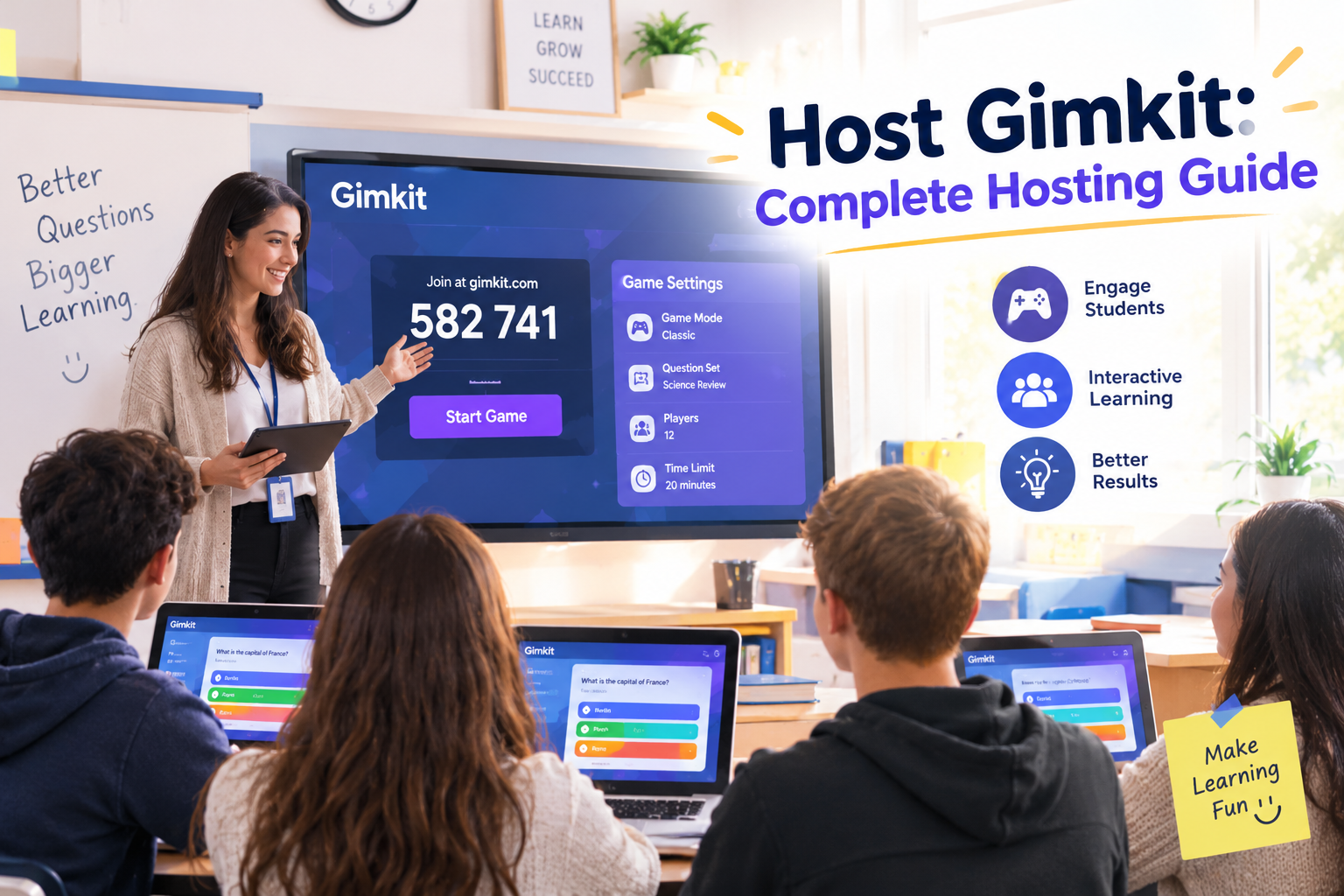
After reviewing the settings, the host starts the game. The platform typically provides a joining method, such as a game code or displayed instructions. The teacher shares the required information with students so they can access the session.
Students open the joining page specified by the platform, enter the necessary information, and follow the instructions to participate. The host should allow enough time for everyone to connect before beginning the main activity.
During the game, the teacher can monitor participation and provide clarification when necessary. At the end of the session, the host can review any available results and use them to identify strengths, weaknesses, and opportunities for additional practice.
Following these steps can help make Host Gimkit sessions organized, accessible, and useful for learning.
How Students Join a Host Gimkit Game
Students need clear instructions when joining a hosted Gimkit session. Even though the process is generally simple, explaining it before the activity begins can prevent unnecessary delays.
First, students should listen to the teacher’s instructions and identify the official joining method. They may need to visit a joining page, enter a game code, and provide a player name or other requested information. The exact process depends on the current platform interface and the settings selected by the host.
Students should make sure they enter the correct code. A missing character or typing error may prevent them from entering the session. If the code does not work, they can ask the host to confirm that the game is active and that the correct joining information has been shared.
Once students successfully join, they should read any instructions displayed on their screens. Some game modes may involve answering questions independently, while others may include teams, shared goals, or additional strategic elements.
A stable internet connection can also improve the experience. If a student disconnects, refreshing the page or following the platform’s reconnection instructions may help, although the best solution depends on the specific problem.
Teachers should avoid sharing game access details publicly when a session is intended for a particular class. Sharing the code only with the intended participants can help maintain an organized learning environment.
Main Features of Host Gimkit
Host Gimkit offers an interactive approach to educational activities by combining question-based learning with game mechanics. The precise features available may depend on the current platform version, account type, and selected game mode.
One important feature is the use of question sets. Teachers can organize questions around particular subjects, units, or skills. A focused question set makes it easier to connect the game with classroom instruction and assess whether students understand the material.
Another important feature is interactive gameplay. Students do more than read questions and write answers on paper. Their responses can influence their in-game progress, giving the activity a more dynamic structure.
Game modes are another major part of the experience. Different modes may offer different objectives and styles of participation. Teachers should review the available choices before starting a session instead of assuming that every mode supports the same type of activity.
Depending on the mode, students may encounter virtual currency, upgrades, individual competition, team-based objectives, or other game mechanics. These elements can make the activity more engaging, but they should support rather than replace the educational purpose.
The host’s control over the session is also important. By selecting content and adjusting available settings, teachers can organize activities for different age groups and learning objectives. Clear instructions help students understand what they are expected to do.
Where results or reports are available, teachers may use them to review performance after the game. Such information can help identify frequently missed questions or topics that require further explanation.
Benefits of Hosting Gimkit for Teachers
Teachers can use Host Gimkit to introduce variety into classroom instruction. Rather than relying entirely on lectures, worksheets, or conventional quizzes, educators can create sessions that invite students to participate actively.
One benefit is improved engagement. Interactive games can encourage students to pay attention and participate throughout a lesson. The combination of questions, goals, and progress may make revision feel less repetitive.
Another benefit is formative assessment. Teachers can use game responses to understand how students are handling particular concepts. If many students struggle with the same question, the teacher can revisit the topic and provide a clearer explanation.
Host Gimkit can also support differentiated instruction. Teachers may prepare easier questions for introductory practice and more challenging questions for advanced learners. This allows the activity to reflect the abilities and needs of the class.
The platform can encourage classroom interaction as well. Depending on the selected mode, students may compete individually or work toward shared objectives. Teachers can use these experiences to discuss teamwork, decision-making, and responsible participation.
Another advantage is flexibility. A hosted game can be used at different stages of a lesson. It may introduce a topic, reinforce information after a lecture, or help students review material before an assessment.
However, teachers should remember that game-based activities work best when they are connected to clear learning goals. A high level of excitement does not necessarily mean that students have mastered the subject. Follow-up explanations, discussion, and independent practice remain important.
Benefits of Host Gimkit for Students
Students can benefit from Host Gimkit because it creates opportunities to practice information in an interactive setting. Answering questions during a game can help learners identify what they know and which areas need more attention.
Immediate interaction can make learning feel more active. Instead of passively receiving information, students respond to questions and observe the consequences of their answers within the game.
Repeated practice may also support recall. When questions are connected to previously taught material, students get another opportunity to retrieve information from memory. This can complement reading, written exercises, and teacher explanations.
Host Gimkit may also encourage strategic thinking. In game modes that include resources or upgrades, students may need to decide how to use their progress. These choices can add another layer of engagement, although they are not a substitute for understanding the subject.
Students who find conventional revision difficult may appreciate the variety offered by interactive activities. Nevertheless, not every student responds to competition in the same way. Some learners may feel anxious when scores are displayed, so teachers should consider the classroom environment and provide alternative ways to participate when appropriate.
The platform can be useful for independent review as well, depending on the features available and the way a teacher organizes the activity. Students should use the questions to strengthen understanding rather than focus exclusively on earning rewards or finishing first.
Using Host Gimkit for Different Subjects
Host Gimkit can support a wide range of school subjects when teachers create relevant questions and select suitable game settings.
In mathematics, teachers can use question sets covering multiplication, division, fractions, percentages, equations, and other concepts. Short practice sessions can help students revisit calculations and identify errors. More difficult questions may be appropriate once learners have developed a strong understanding of the basics.
In science, a host can prepare questions about ecosystems, energy, matter, the human body, or scientific vocabulary. The activity can reinforce definitions and key concepts introduced during lessons.
Language teachers can use Gimkit to practice vocabulary, grammar, spelling, sentence structure, and reading comprehension. Students may benefit from revisiting unfamiliar words and identifying the correct usage of grammatical forms.
History and geography are also suitable subjects for question-based activities. Teachers can prepare questions about historical events, important figures, countries, capitals, physical features, and significant dates. Contextual explanations should follow the game so students understand the meaning behind the answers.
For computer studies, a host might create questions about internet safety, digital literacy, basic programming, or common technology concepts. This can make technical vocabulary easier to review in a structured environment.
The most effective approach is to match the content to the lesson. A question set should reinforce material students have studied or introduce concepts at a level they can reasonably understand.
Host Gimkit for Online Learning
Online learning creates challenges that differ from those found in a physical classroom. Students may be connecting from different locations, using different devices, or dealing with varying internet speeds. Host Gimkit can provide a shared activity that helps online lessons feel more interactive.
A teacher can introduce the game during a live online class and share the joining instructions through the approved classroom communication channel. Students can then participate from their own devices while the teacher manages the session.
Before beginning, the host should explain the purpose of the activity and confirm that students understand how to join. This is especially important when students are unfamiliar with the platform.
The teacher should also consider accessibility. Some students may have limited bandwidth, older devices, or difficulties using a particular interface. Providing clear instructions and allowing reasonable time to connect can reduce unnecessary frustration.
A hosted game can work as a short review between longer instructional sections. For example, after explaining a science concept, the teacher can run a brief question set to see whether students understand the main ideas.
However, online participation should not be judged only by speed or score. Technical difficulties can affect performance, and a student who responds slowly may still understand the content. Teachers should use the activity as one source of information rather than the only measure of learning.
Best Practices for Hosting a Successful Gimkit Session
A successful Host Gimkit session begins with a clear objective. Before choosing questions, teachers should decide what students should learn or review. The objective may involve remembering definitions, applying a mathematical procedure, identifying key facts, or checking understanding of a recent lesson.
Question quality is equally important. Questions should be clear, accurate, and appropriate for the intended learners. Ambiguous wording or incorrect answers can confuse students and undermine the educational value of the activity.
The host should also choose a suitable game mode. A competitive format may be effective for a quick revision activity, while a collaborative format may be more appropriate when the lesson emphasizes teamwork. The teacher should consider the needs of the class rather than choosing a mode simply because it appears more exciting.
Time management matters as well. A game that is too short may end before students have a meaningful opportunity to practice. An activity that is too long may reduce concentration or leave insufficient time for discussion. The appropriate duration depends on the lesson and the number of questions.
Clear rules can make the experience more inclusive. Teachers should explain expectations for respectful behavior, device use, and participation before starting the session.
After the game, the teacher should review the most important questions and discuss common mistakes. This follow-up helps turn the activity into a learning opportunity instead of a competition that ends when the scores appear.
Finally, teachers should collect feedback when appropriate. Asking students what they found helpful or confusing can guide improvements to future sessions.
Common Host Gimkit Problems and Their Solutions
Users may occasionally experience problems while trying to host or join a Gimkit game. Many issues can be addressed by checking the connection, session settings, and joining instructions.
One common issue is an invalid game code. Students should verify that they have entered the correct code and that the session is still active. The host can confirm the current joining information and share it again if necessary.
Another problem is a slow or unstable internet connection. A participant may have difficulty loading questions or staying connected. Checking the network, closing unnecessary browser tabs, or switching to a more reliable connection may improve performance.
Some users may find that a page does not load correctly. Refreshing the page or opening the official platform in an updated, compatible browser may help. If the problem continues, users should consult the platform’s official support resources.
A game may also fail to meet the teacher’s expectations because the wrong question set or mode was selected. Reviewing the content and settings before starting can prevent this issue. A short test or preview, where available, can help confirm that the activity is ready.
Students may sometimes focus more on winning than learning. Teachers can address this by emphasizing the lesson objective and discussing the reasoning behind answers. Recognizing thoughtful participation and improvement can help balance competition with understanding.
If an account-related or platform-wide problem occurs, the host should follow the official guidance instead of relying on unfamiliar websites that promise unofficial solutions.
Read more about: blog whatutalkingboutwillis
Host Gimkit and Classroom Engagement
Classroom engagement involves more than keeping students busy. A productive activity should encourage attention, participation, and meaningful interaction with the subject.
Host Gimkit can support engagement by giving students a clear task and an opportunity to respond. The game format can create a sense of progress, which may encourage learners to continue practicing.
Teachers can make the activity more meaningful by connecting questions to real examples. For instance, a mathematics question about percentages can relate to shopping discounts, while a science question about energy can connect to everyday household devices.
Discussion is another valuable part of classroom engagement. After a question, the teacher can explain why an answer is correct and why other options are incorrect. This encourages students to think beyond guessing and consider the underlying concept.
Teachers should also monitor how different learners respond. Some students may enjoy fast-paced competition, while others may benefit from additional time or a less competitive format. Adjusting the approach can help make the activity useful for a wider range of students.
The overall aim of Host Gimkit should be to strengthen learning, not merely increase excitement. When the game is carefully connected to instruction, it can become a useful part of a broader teaching strategy.
Is Host Gimkit Suitable for Every Classroom?
Host Gimkit can be useful in many educational settings, but its suitability depends on the students, subject, available devices, and teaching objectives.
Classes with reliable internet access and compatible devices may find it relatively easy to organize a shared game. In settings with limited technology, teachers may need to adapt the activity or select a different learning method.
Age and learning level also matter. Younger students may need additional instructions, while older learners may benefit from challenging questions that require analysis or application. The host should ensure that the selected content is appropriate for the group.
Competition is another consideration. Some students enjoy leaderboards and scores, while others may feel uncomfortable when their performance is compared publicly. Teachers can choose suitable modes, adjust the classroom approach, and emphasize learning rather than ranking.
Gimkit should not replace all other teaching methods. Reading, discussion, writing, practical activities, and independent problem-solving remain important parts of education. A game is most effective when it complements these approaches.
Teachers should also review the platform’s current terms, privacy information, and account requirements before using it with students. School policies and age-related requirements may influence how the platform should be introduced in a classroom.
Host Gimkit Compared With Traditional Quizzes
Traditional quizzes and interactive games both help teachers review learning, but they offer different experiences.
A conventional quiz may provide a quiet environment in which students work independently and demonstrate their understanding without game mechanics. This can be useful for formal assessment, written practice, and tasks that require detailed explanations.
Host Gimkit introduces an interactive format in which answers influence progress through a game. The experience may encourage more participation and make repeated practice feel less repetitive.
However, the two approaches should not necessarily be treated as competitors. A teacher might use Gimkit for an introductory review and then assign a written quiz to check individual understanding. This combination allows students to benefit from engagement while still demonstrating their knowledge through other methods.
The choice depends on the learning objective. If the teacher wants a quick, interactive revision session, hosting Gimkit may be appropriate. If the goal is to evaluate extended written reasoning, a conventional assignment may be more suitable.
Using different assessment formats can provide a broader understanding of student performance and help teachers avoid relying too heavily on a single activity.
Responsible and Safe Use of Host Gimkit
Responsible use is important whenever students participate in online educational activities. Teachers should explain how to join the game safely and make sure participants understand the rules for appropriate behavior.
Students should follow the teacher’s instructions and avoid sharing personal information unnecessarily. When choosing player names, they should use names or identifiers permitted by the classroom’s policies.
Teachers should also use the official platform and review the relevant privacy information. It is sensible to avoid entering sensitive student details into public question sets or sharing private classroom information through public channels.
Another important consideration is digital balance. Interactive games can be engaging, but they should be used for a clear educational purpose and for an appropriate amount of time. Teachers can combine short gaming sessions with discussion, reading, and practical work.
Respectful participation should remain a priority. Students should not use the activity to embarrass classmates, post inappropriate names, or disrupt the learning environment. Clear expectations can help keep the session welcoming and productive.
For current platform information, users can visit the official Gimkit website at https://www.gimkit.com. They can also explore broader guidance on digital learning through the U.S. Department of Education’s educational technology resources at https://tech.ed.gov/.
How Host Gimkit Supports Modern Education
Modern education increasingly combines traditional instruction with digital resources. Teachers use online tools to create activities that encourage participation, provide practice, and support different learning preferences.
Host Gimkit fits into this environment by turning question-based revision into a game. Students can interact with educational content while teachers organize the activity around specific classroom goals.
Digital learning tools can also help teachers vary their instructional methods. A lesson might include an explanation, a demonstration, a group discussion, and a short game-based review. This variety can create opportunities for students to engage with the material in different ways.
However, educational technology is valuable only when it serves a meaningful purpose. Teachers should consider whether a platform supports the intended learning outcome, whether students can access it, and whether the activity provides useful feedback.
Host Gimkit is best viewed as one option within a larger collection of teaching strategies. Its value depends on the quality of the questions, the suitability of the game mode, and the way the teacher connects the experience to classroom learning.
Future Potential of Host Gimkit
Interactive educational platforms may continue to evolve as schools explore new ways to support digital learning. Teachers increasingly look for tools that can make practice more engaging without sacrificing educational quality.
The future usefulness of Host Gimkit will depend on how its features develop, how accessible the platform remains, and how effectively teachers integrate it into instruction. Improvements to game options, reporting tools, usability, or content management could influence how educators use the platform, although specific future changes should not be assumed without official announcements.
Teachers will continue to play an important role in making game-based learning effective. Technology can provide an interactive structure, but educators still need to select appropriate questions, explain concepts, support students, and evaluate whether learning objectives have been achieved.
Students can also develop more effective learning habits by treating games as opportunities to practice rather than simply win. Reviewing incorrect answers and asking questions after a session can help turn an entertaining activity into a meaningful educational experience.
As digital learning develops, Host Gimkit may remain a useful option for teachers who want to combine structured practice with interactive participation. Its long-term value will depend on the educational goals it helps users achieve.
Conclusion
Host Gimkit provides teachers and students with an interactive way to review lessons, practice questions, and encourage classroom participation. By choosing suitable question sets, selecting the right game mode, and discussing results afterward, educators can turn game-based activities into meaningful learning experiences. For the best results, Host Gimkit should complement traditional teaching methods and remain focused on clear educational goals.