
Table of Contents
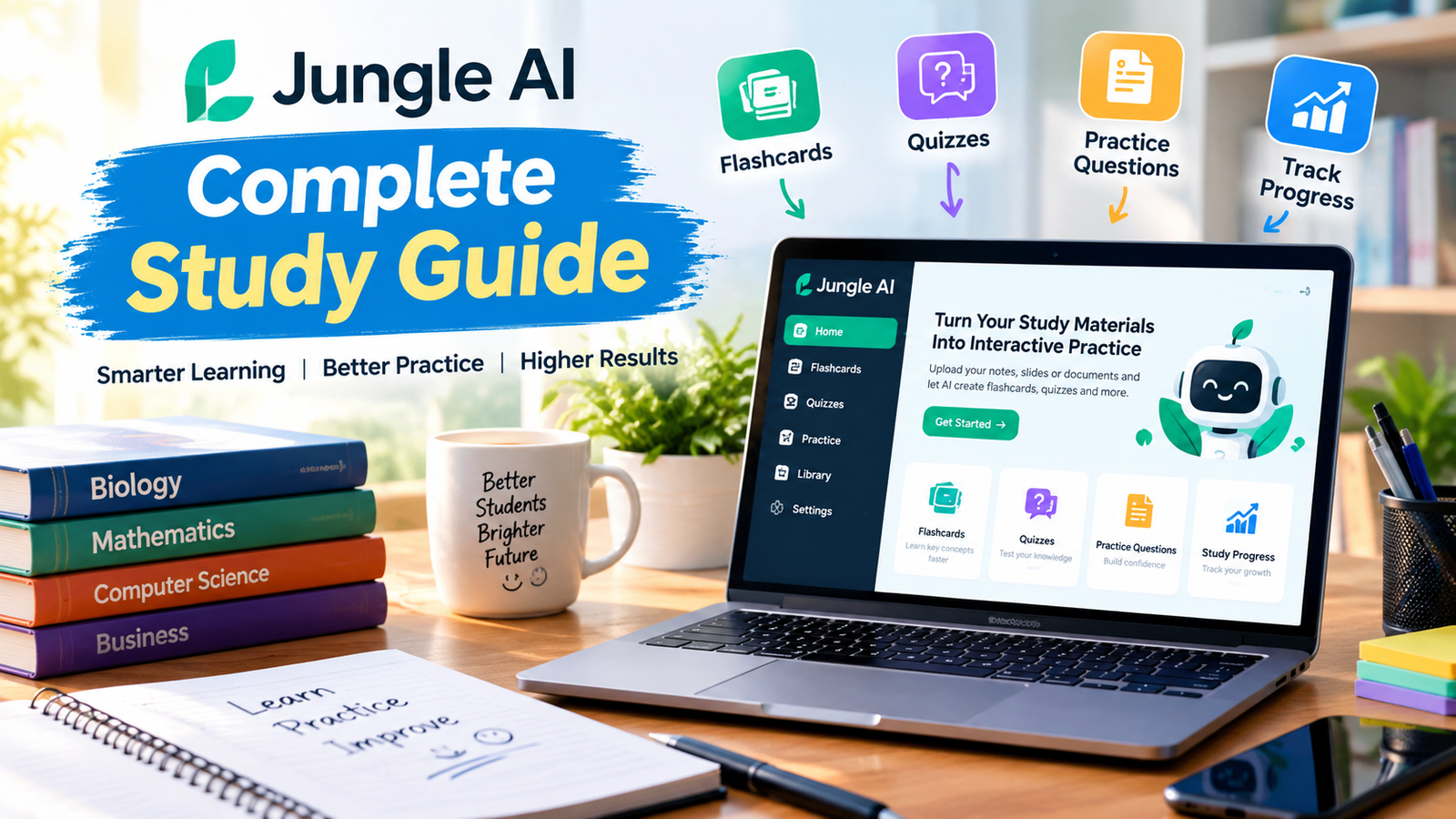
Jungle AI is an artificial intelligence study platform designed to make learning more interactive, organized, and effective. Students often spend hours reading lecture slides, reviewing textbooks, watching educational videos, and preparing notes before examinations. Although these traditional methods remain useful, they can sometimes make studying time-consuming and difficult to manage. Jungle AI offers a different approach by helping learners transform educational materials into practice questions, flashcards, and other useful study resources.
The main purpose of Jungle AI is to help students move beyond passive reading and develop a more active learning routine. Instead of repeatedly reading the same information, learners can use AI-generated questions to test their understanding and identify topics that require additional attention. This approach can make revision more focused and help students use their available study time effectively.
Jungle AI is particularly relevant for university students, college learners, and anyone who regularly works with large amounts of educational information. Its features can support examination preparation, daily revision, and the development of long-term learning habits. However, the quality of the results still depends on the source material, the accuracy of generated questions, and the student’s willingness to review mistakes carefully.
Understanding how Jungle AI works, what it offers, and where its limitations exist can help students decide whether this AI study tool fits their individual learning needs.

What Is Jungle AI?
Jungle AI is an AI-powered learning platform that converts educational content into interactive practice materials. Students can provide learning resources and use the platform to generate questions that help them review important concepts. Depending on the available features and supported material, these resources can include lecture slides, documents, and video-based educational content.
The idea behind Jungle AI is simple: students already possess much of the information they need, but turning that information into effective practice materials requires time and effort. Preparing flashcards manually, writing examination questions, and organizing revision notes can become difficult when several subjects demand attention simultaneously.
Jungle AI aims to reduce this preparation workload by automating parts of the process. Students can concentrate more on answering questions, understanding difficult concepts, and identifying gaps in their knowledge rather than spending all their available time creating study resources.
Another important aspect of Jungle AI is active learning. Active learning encourages students to recall information, answer questions, and apply concepts instead of relying entirely on repeated reading. When learners regularly test themselves, they can discover which topics they understand and which require further revision.
Nevertheless, Jungle AI should be viewed as a learning assistant rather than a replacement for teachers, textbooks, or independent thinking. It can organize and simplify revision, but students remain responsible for checking information and developing genuine understanding.
How Jungle AI Works
The Jungle AI learning process generally begins with educational material. A student selects relevant lecture slides, notes, or another supported source and provides it to the platform. The system then processes the available information and generates practice activities based on the material.
For example, a biology student might upload lecture slides about the human digestive system. Jungle AI can use the supplied content to create questions about digestion, nutrient absorption, and the functions of different organs. The student can answer these questions to check whether the central concepts are understood.
This process can also help learners discover weak areas. If a student repeatedly struggles with questions about a particular topic, that subject may deserve additional attention. Instead of reviewing every page equally, the student can concentrate on the concepts that need improvement.
The platform also supports interactive practice through different question formats. Multiple-choice questions can help students recognize correct answers, while free-response questions encourage them to recall information independently. Case-based questions can provide opportunities to apply knowledge to more complex situations.
However, AI-generated material is not automatically perfect. A question may occasionally be unclear, incomplete, or based on an incorrect interpretation of the original content. Students should compare important answers with trusted course materials, particularly when preparing for high-stakes examinations.
Main Features of Jungle AI
AI-Powered Flashcard Creation
Flashcards are among the most useful resources for reviewing definitions, facts, formulas, and important concepts. Creating them manually can take considerable time, especially when students have several chapters to study.
Jungle AI helps simplify this process by generating flashcards from supported educational materials. Instead of writing every question and answer individually, learners can use the generated content as a starting point for revision.
For example, a medical student could review terminology, while a history student could practice important dates and historical developments. A computer science student might use flashcards to remember programming concepts and technical definitions.
The usefulness of AI-generated flashcards depends on their accuracy and clarity. Students should correct mistakes, remove unnecessary information, and rewrite complicated explanations when needed. Personalized flashcards are often more valuable than accepting every generated card without review.
Multiple-Choice Questions
Multiple-choice questions are widely used in school, college, university, and professional examinations. They allow students to practice recognizing correct answers while learning to distinguish between similar concepts.
Jungle AI can generate multiple-choice questions from educational resources, helping learners prepare for assessments without manually writing every question. Well-designed questions can also challenge students to think carefully about why one answer is correct and the alternatives are incorrect.
For the best results, students should avoid memorizing answer positions. Instead, they should understand the reasoning behind each response. Reviewing incorrect answers is especially important because mistakes can reveal misunderstandings that might otherwise remain unnoticed.
Free-Response Practice
Free-response questions require students to produce answers rather than select them from a list. This makes them useful for testing independent recall and developing a deeper understanding of academic subjects.
Jungle AI offers this type of practice alongside other question formats. A learner might be asked to explain a scientific process, define an important term, or describe the relationship between two concepts.
Answering without looking at notes can help students identify whether they genuinely understand the material. After completing a question, learners should compare their response with reliable information and correct any missing or inaccurate details.
Case-Based Questions
Some subjects require more than memorizing definitions. Medicine, business, science, and other fields often involve applying knowledge to practical situations.
Case-based questions can help students practice this skill by presenting information that requires interpretation. Instead of simply recalling a fact, learners must identify relevant details and use their knowledge to develop an answer.
Jungle AI can support this type of practice when the source material and available question-generation features are suitable. Students should still confirm that the difficulty level and question style match their actual course requirements.
Interactive Learning Experience
Jungle AI combines study activities with an interactive learning environment. Its design encourages learners to participate actively rather than treating revision as a completely passive task.
Interactive practice can make long study sessions feel more manageable. Students can work through questions, evaluate their understanding, and return to difficult material when necessary.
The platform also includes a gamified element in which learners grow trees as they answer questions. This feature adds a visual sense of progress and may encourage students to maintain a consistent revision routine.
Gamification can support motivation, but it should not become the main objective. Completing many questions is less important than understanding the answers and remembering the information when it is needed.
Benefits of Using Jungle AI
Saves Preparation Time
One major advantage of Jungle AI is its ability to reduce the time required to prepare practice materials. Students who normally create flashcards and quizzes manually can use AI-generated resources as a starting point.
This can be particularly helpful during examination periods when several subjects compete for attention. Instead of spending hours preparing every question, students can dedicate more time to reviewing information and correcting mistakes.
However, the time saved should not come at the expense of accuracy. Checking generated material remains an essential part of responsible studying.
Supports Active Recall
Active recall involves retrieving information from memory rather than simply reading it again. Jungle AI supports this learning approach by providing questions that require students to produce or select answers.
Regular practice can reveal whether a concept is genuinely understood. When students struggle to answer a question, they can revisit the relevant material and try again.
This method works best when practice is repeated over time. A single quiz may show current understanding, but consistent revision can help students maintain knowledge for longer periods.
Improves Revision Organization
Managing multiple subjects can become confusing when notes, textbooks, and examination resources are scattered across different places. Jungle AI can help students turn existing materials into structured practice activities.
This organization makes it easier to approach revision with a clear purpose. A learner can work through questions connected to a specific lecture or topic and identify areas that need further review.
Good organization also reduces the temptation to spend an entire study session deciding what to do next.
Encourages Consistent Study Habits
Successful learning usually requires regular effort rather than occasional periods of intensive revision. Jungle AI’s interactive features may encourage learners to practice more consistently.
Students can establish realistic daily targets, complete short sessions, and review difficult subjects throughout the week. These habits can make preparation feel less overwhelming as examinations approach.
The best routine is one that remains manageable over time. Students should choose study sessions that fit their schedules rather than setting unrealistic targets that become difficult to maintain.
Helps Identify Knowledge Gaps
Reading a chapter can create the impression that everything is understood, even when important details cannot be recalled independently. Practice questions provide a more direct way to test that understanding.
Jungle AI can help students identify concepts that need additional work. For example, a learner may answer questions about basic definitions correctly but struggle when asked to apply those definitions to a new situation.
Recognizing this difference helps students direct their attention toward meaningful improvement.
Who Should Use Jungle AI?
Jungle AI may be useful for university students who regularly study from lecture slides and lengthy course documents. Its question-generation features can help them prepare for examinations, organize revision, and practice important concepts without creating every resource manually.
College students may also benefit from using Jungle AI for daily learning. Short practice sessions can reinforce lessons covered in class and help learners discover misunderstandings before major assessments.
Medical and science students often work with complex terminology, processes, and detailed information. Flashcards and practice questions can support revision, although students should verify technical information against authoritative textbooks and course materials.
Students studying business, economics, computing, and other analytical subjects may find generated questions useful for reviewing theories and definitions. Case-based practice can also help when it reflects the application-focused requirements of their courses.
Teachers and tutors may explore AI-generated questions as supplementary learning resources. However, they should review the material carefully before using it in formal assessments or distributing it to students.
Jungle AI is not equally suitable for every learning task. Students who need extensive essay feedback, specialist research guidance, or advanced subject-specific instruction may require additional tools and direct support from qualified educators.
Jungle AI for Examination Preparation
Examination preparation becomes easier to manage when students divide a large syllabus into smaller, achievable tasks. Jungle AI can support this approach by turning course materials into questions for topic-by-topic practice.
A student preparing for an examination could begin by reviewing the relevant lecture materials and generating practice questions. After answering them, the student can identify incorrect responses and revisit the associated concepts.
The next session can focus on those weak areas before moving to another subject. This creates a practical cycle of studying, testing, correcting mistakes, and repeating difficult material.
Students should also practice under conditions similar to their actual examinations. If the examination requires written explanations, multiple-choice questions alone may not provide sufficient preparation. If the assessment involves calculations, practical exercises and worked examples remain essential.
Jungle AI can therefore complement an examination plan, but it should not determine the entire plan. Students need to understand their syllabus, assessment format, and learning objectives before choosing the most appropriate practice activities.
Is Jungle AI Easy to Use?
Jungle AI is designed to simplify the process of creating study resources. Its central workflow involves supplying educational material and using generated questions or flashcards for practice.
This approach may be easier for students than manually preparing every revision resource. Learners who already use digital documents, lecture slides, and online educational materials may find the process relatively straightforward.
Nevertheless, individual experiences can vary according to the source material, the features available, and the student’s familiarity with digital learning platforms.
Before relying on Jungle AI for an important examination, users should experiment with a small amount of material. This allows them to evaluate question quality, understand the workflow, and determine whether the platform fits their preferred learning style.
Students should also check the current website for supported file formats, account requirements, and any restrictions that may affect their use.
Is Jungle AI Free?
Students researching Jungle AI should check its current pricing and account options before deciding whether to use it regularly. Availability, usage limits, and paid features can change over time, so it is better to consult the official platform than rely on outdated descriptions.
The platform’s terms describe both free and paid subscription options, although the specific limits and benefits should be confirmed directly. A free option can be useful for testing whether the study workflow matches individual needs before considering a subscription.
Students should evaluate the value of any paid plan according to their actual study habits. Someone who needs occasional flashcards may have different requirements from a university student preparing several subjects each week.
It is also sensible to review renewal terms, cancellation conditions, and payment details before purchasing a subscription. The most suitable option is one that provides useful learning features without creating unnecessary financial pressure.
read more about: magic hour ai
Limitations of Jungle AI
Although Jungle AI can make revision more convenient, it has limitations that students should understand. The first is that AI-generated content may contain errors. If the source material is unclear or incomplete, generated questions may also miss important details.
The second limitation concerns depth. A short question can test a definition, but it may not fully evaluate a student’s ability to write an essay, solve a complex problem, or explain a complicated argument.
Another consideration is dependence on automated resources. Students who rely entirely on generated questions may overlook topics that the platform does not cover. Reviewing the original syllabus and course materials remains important.
Learning preferences also differ. Some students benefit from interactive quizzes, while others learn effectively through diagrams, discussions, demonstrations, or handwritten notes. Jungle AI should fit into a broader learning strategy rather than replace every other method.
Privacy deserves attention as well. Before uploading course documents or personal information, users should review the platform’s privacy policy and understand how submitted materials and account information may be handled.
Finally, generated questions should not automatically be treated as official examination questions. Students should use them for practice and continue following guidance from their teachers, lecturers, and educational institutions.
Jungle AI Compared With Traditional Studying
Traditional studying includes reading textbooks, reviewing lecture notes, writing summaries, and practicing questions provided by teachers. These methods remain valuable because they allow learners to explore detailed explanations and follow an established curriculum.
Jungle AI adds automation to part of this process. It can help transform existing materials into interactive questions, reducing the manual work involved in preparing revision activities.
The two approaches are most effective when combined. Students can first study a topic using reliable course materials, then use Jungle AI to test their understanding. After answering questions, they can return to the textbook to investigate mistakes and clarify confusing concepts.
This balanced approach preserves the depth of traditional learning while taking advantage of AI-assisted practice. It also reduces the risk of accepting generated content without checking its accuracy.
The goal is not to replace established educational methods but to make them easier to use consistently.
Tips for Getting Better Results With Jungle AI
Students should begin with clear, relevant learning materials. Well-organized lecture slides and accurate notes generally provide a better foundation for generating useful practice questions than incomplete documents.
It is also helpful to divide large subjects into manageable sections. Studying one chapter or concept at a time makes it easier to recognize progress and focus on specific weaknesses.
Learners should answer questions before checking the solutions whenever possible. This encourages genuine recall instead of passive recognition. When an answer is incorrect, they should review the explanation and return to the original source.
Repeating difficult questions after a suitable interval can reinforce understanding. Students can also combine flashcards with written practice, diagrams, and discussions to develop a more complete understanding of the subject.
Most importantly, they should evaluate the quality of generated content. If a question appears inaccurate, confusing, or unrelated to the syllabus, it should be checked rather than memorized.
Conclusion
Jungle AI offers a practical way to turn educational materials into interactive study resources. Its flashcards, quizzes, and practice questions can help students organize revision, test their knowledge, and identify weaknesses. For the best results, learners should combine Jungle AI with reliable course materials, regular practice, and careful fact-checking.