
Table of Contents
Artificial intelligence is changing how people work, learn, communicate, and use digital services. In 2026, AI technology trends are becoming more important as businesses, students, developers, and content creators discover new ways to use intelligent tools. From AI assistants and automated workflows to advanced robotics and personalized learning, artificial intelligence is influencing many areas of modern life. These developments are not only improving existing technologies but also creating new opportunities for innovation, productivity, and business growth.
Understanding AI technology trends in 2026 can help individuals and organizations make better decisions about digital tools and emerging technologies. Instead of using AI only to answer questions, people are increasingly exploring systems that can analyze information, generate content, support decision-making, and complete tasks with limited supervision. However, these developments also raise important questions about privacy, accuracy, cybersecurity, and responsible use. Learning about the latest AI innovations can help users understand both their potential benefits and their limitations.
What Are AI Technology Trends in 2026?
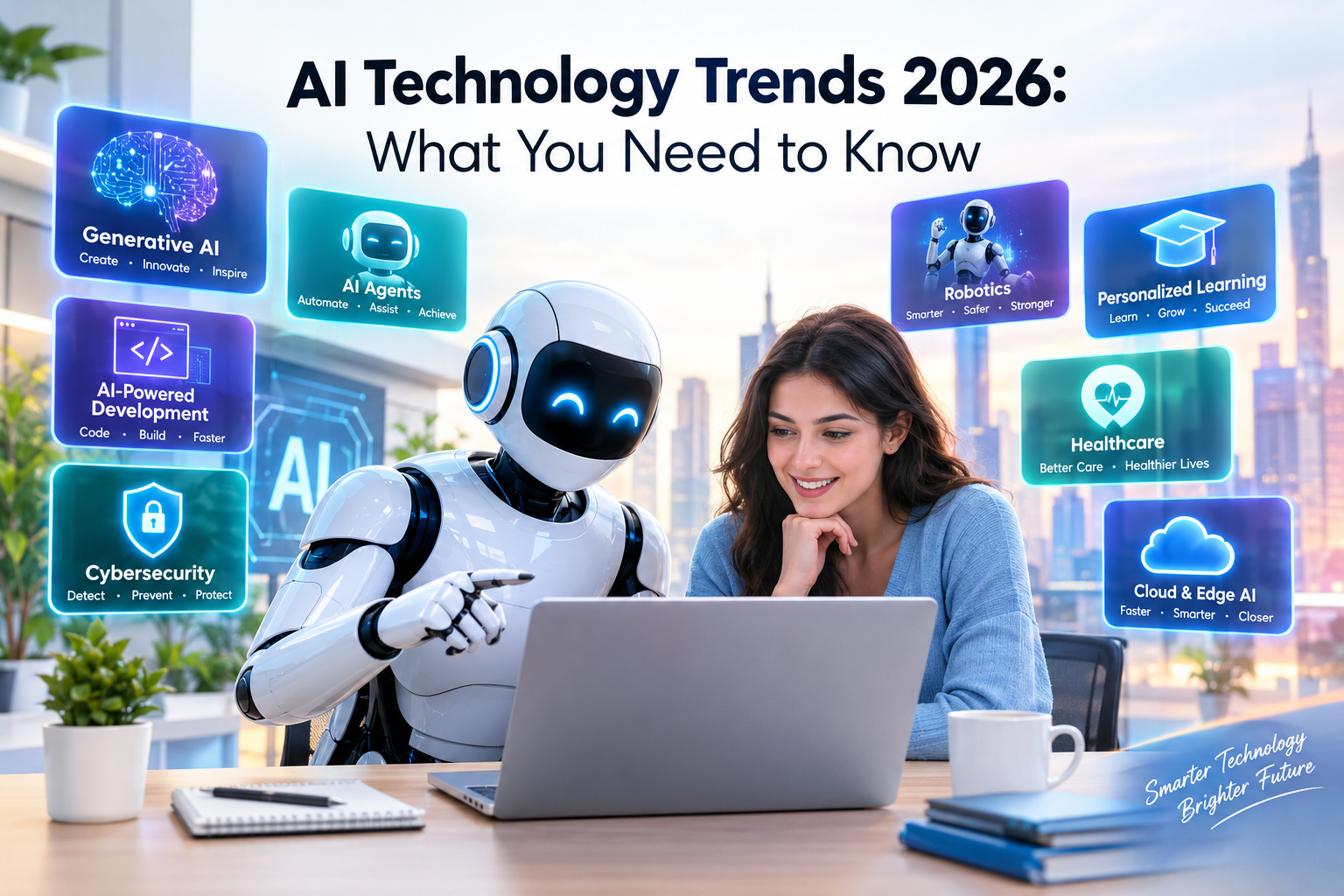
AI technology trends refer to the latest developments, tools, methods, and applications that are changing how artificial intelligence is created and used. These trends include generative AI, autonomous AI agents, multimodal systems, AI-powered software development, intelligent automation, and AI-assisted cybersecurity. Each development offers different opportunities depending on the needs of individuals, businesses, and industries.
In 2026, a major focus is shifting from experimenting with AI tools to integrating them into everyday activities. Businesses are exploring ways to connect AI systems with existing software, while individuals are using intelligent assistants to research topics, organize information, and improve their productivity. According to Microsoft’s 2026 AI diffusion reporting, global adoption continued to increase during the first half of the year, showing how AI is becoming more widely used across different economies.

Another important change is the development of specialized AI systems. Instead of relying on one general-purpose tool for every task, organizations can use systems designed for customer support, software development, research, marketing, and data analysis. These applications make AI technology trends relevant to people with different professional backgrounds and technical skills.
1. AI Agents and Intelligent Automation
AI agents are among the important AI technology trends to understand in 2026. Unlike a basic chatbot that mainly responds to individual questions, an AI agent can work toward a defined goal, organize multiple steps, use approved tools, and report its results. Depending on its design and permissions, an agent may help manage information, prepare reports, analyze documents, or coordinate parts of a business workflow.
For example, a small business owner could use an AI agent to organize customer inquiries, categorize common questions, and prepare draft responses. A researcher might use an agent to collect information from approved sources and summarize important findings. These systems can reduce repetitive work and allow people to focus on decisions that require experience, judgment, and creativity.
However, AI agents are not completely independent or always reliable. They can misunderstand instructions, use incorrect information, or perform an action that requires additional approval. Users should establish clear permissions, review important outputs, and keep human supervision in place for sensitive activities.
As these tools develop, businesses will need to evaluate whether an AI agent actually improves productivity. Successful implementation depends on choosing the right task, connecting reliable information sources, protecting private data, and measuring the quality of the results.
2. Generative AI for Content Creation
Generative AI continues to influence writing, graphic design, video production, and digital marketing. These systems can create new content from user instructions, including text, images, audio, and other media. For bloggers, designers, educators, and marketers, generative AI offers a way to explore ideas and speed up parts of the creative process.
For example, a content creator can use an AI tool to develop article outlines, suggest headlines, organize research notes, or generate ideas for social media posts. Image generation tools can help designers explore different visual concepts before producing a final design. Video tools can assist with scripts, subtitles, storyboards, and selected editing tasks.
One of the most useful AI technology trends is the combination of human creativity with machine assistance. AI can provide a starting point, but high-quality content still requires fact-checking, editing, originality, and an understanding of the intended audience. Automatically generated material may contain inaccurate claims, repetitive language, or details that do not match the user’s needs.
For website owners, the best approach is to use AI as a support tool rather than a replacement for useful information and original experience. Articles should answer real questions, provide clear explanations, and offer information that readers cannot easily obtain from a collection of generic paragraphs.
3. Multimodal Artificial Intelligence
Multimodal AI is another important development in modern technology. Traditional AI applications often focus on a single type of information, such as written text or images. Multimodal systems can work with different forms of input, including text, pictures, audio, and video, depending on their capabilities.
This development makes AI tools more flexible and practical. A student may upload an image of a diagram and ask for a simple explanation. A professional might provide a document and a chart to receive a combined summary. A user may interact with a compatible assistant through voice rather than typing every instruction.
Multimodal AI can also support accessibility. For example, image descriptions may help people understand visual information, while speech recognition and text-to-speech tools can make digital services easier to use. In education, these systems can explain complicated material through a combination of written instructions and visual examples.
Despite these benefits, multimodal systems can make mistakes when interpreting images, sounds, or video. Users should verify important information, particularly when dealing with technical instructions, financial decisions, or other sensitive matters. Privacy also matters because uploaded files may contain personal details that should not be shared without understanding the service’s data policies.
4. AI-Powered Software Development
Software development is changing as AI tools become more capable of helping programmers write, review, test, and explain code. Developers can use these systems to identify possible errors, understand unfamiliar code, generate basic functions, and create documentation. These capabilities can make some development tasks faster, especially when the requirements are clear.
AI-assisted programming is useful for experienced developers as well as beginners. New learners can request explanations of programming concepts, while experienced professionals can use AI to explore alternative approaches or investigate common errors. Small businesses may also benefit from faster prototyping when developing internal tools or testing new product ideas.
Nevertheless, AI-generated code should not automatically be considered correct or secure. A program may contain hidden bugs, inefficient logic, or vulnerabilities that are difficult to notice at first glance. Developers must test generated code, review dependencies, protect sensitive information, and follow appropriate security practices.
The future of software development will likely involve stronger cooperation between human developers and AI systems. Human expertise will remain essential for understanding user needs, designing reliable systems, making architectural decisions, and ensuring that software behaves as intended.
5. Personalized Learning Through AI
Education is another area being influenced by AI technology trends in 2026. Intelligent learning tools can explain difficult subjects, create practice questions, summarize study material, and adjust explanations to different learning levels. These features can help students study independently and identify topics that need additional attention.
For example, a student learning mathematics can request a step-by-step explanation of a problem. Someone studying a foreign language can practice conversations and receive feedback on grammar. Teachers can use suitable AI tools to prepare lesson outlines, generate examples, and organize learning activities.
Personalized learning can make education more flexible because students do not always need to follow the same pace or use the same explanation. AI tools can offer additional examples when a topic is difficult and provide practice activities when a learner wants to improve a particular skill.
However, AI should support learning rather than replace it. Students need to understand the material instead of copying answers without checking them. Teachers and learners should verify facts, follow school policies, and use AI responsibly. The quality of AI-assisted education also depends on internet access, suitable devices, language support, and the availability of reliable learning resources.
6. AI in Healthcare and Medical Research
Healthcare is an important field for AI development because medical professionals work with large amounts of information. AI systems can help researchers analyze scientific data, support medical image assessment, organize records, and identify patterns that may deserve further investigation. These applications may improve certain research and administrative processes when they are properly tested and supervised.
In medical research, AI can help scientists examine complex datasets and explore potential relationships between different biological factors. Healthcare organizations may also use automation to reduce repetitive administrative work, allowing staff to spend more time on patient communication and other important responsibilities.
However, medical AI requires particularly careful evaluation. A system can produce incorrect suggestions or perform differently across patient groups. Clinical decisions must consider professional expertise, patient history, validated evidence, and applicable regulations. AI-generated health information should not replace an examination or diagnosis by a qualified healthcare professional.
As AI technology advances, transparency, privacy, safety testing, and human oversight will remain essential. The goal should be to use technology to support healthcare professionals and improve patient care rather than assume that automated systems can solve every medical problem.
7. AI Cybersecurity and Online Privacy
Cybersecurity is becoming increasingly important as more organizations adopt artificial intelligence. AI-powered security systems can help identify unusual activity, analyze large volumes of security information, and detect patterns that may indicate suspicious behavior. These capabilities can support faster investigations and help security teams prioritize potential threats.
At the same time, cybercriminals may use AI to create more convincing phishing messages, automate parts of online scams, or produce misleading content. This means that AI technology trends have both defensive and offensive implications for digital security.
Individuals can reduce common risks by using strong, unique passwords, enabling multifactor authentication, updating software, and checking suspicious links before opening them. Businesses should establish access controls, maintain backups, and train employees to recognize social engineering attempts.
Privacy also deserves attention when using AI tools. Users should avoid uploading confidential business documents, passwords, private customer information, or sensitive personal records unless the service is approved for that purpose. Reading privacy policies and understanding data retention settings can help people make more informed decisions.
Organizations can learn more about responsible AI practices through the official resources provided by Google. Its Responsible AI Progress Report discusses approaches to developing and managing AI systems with attention to safety and responsibility.
8. AI in Robotics and Physical Automation
Artificial intelligence is also improving how robots understand their surroundings and perform physical tasks. AI-powered robots can combine information from cameras, sensors, and other systems to navigate environments, recognize objects, or assist with specific activities. These capabilities are relevant to manufacturing, logistics, agriculture, and selected service applications.
In factories, intelligent automation can support repetitive production tasks and help identify potential equipment problems. In warehouses, robots may assist with moving products and organizing inventory. Agricultural applications can use automated systems to monitor crops or support certain precision-farming activities.
Humanoid robots are attracting attention because their human-like form may allow them to operate in environments designed for people. However, practical performance varies considerably, and many advanced robotic applications remain expensive or limited to specific tasks.
The combination of AI and robotics is an important technology trend because it connects digital intelligence with the physical world. Nevertheless, safe deployment requires reliable hardware, careful testing, suitable operating environments, and human supervision where mistakes could cause injury or damage.
9. Small and Efficient AI Models
Large AI models can perform many sophisticated tasks, but they may require significant computing resources. As a result, developers are also working on smaller and more efficient models that can operate with fewer resources or run closer to where data is collected.
This approach can be useful for mobile applications, smart devices, industrial equipment, and systems that need quick responses. Depending on the hardware and model, some tasks can be completed locally without sending every request to a remote server. Local processing may improve responsiveness and reduce certain privacy risks.
Smaller models can also help organizations manage operating costs. A business does not necessarily need its most expensive AI system for every task. A lightweight model may be sufficient for classifying documents, answering a limited set of questions, or extracting information from structured records.
However, smaller models may not perform as well as larger systems on complex tasks. Organizations should compare accuracy, speed, resource requirements, security, and maintenance needs before selecting a solution. Efficient AI is not simply about choosing the smallest model; it is about matching the technology to the actual problem.
Read more about: Technology
10. AI Governance and Responsible Innovation
As artificial intelligence becomes more widely used, responsible governance is emerging as a major priority. AI governance includes the policies, processes, testing methods, and oversight systems used to manage how AI is developed and deployed. Its purpose is to reduce risks while allowing useful innovation to continue.
Organizations need to consider accuracy, fairness, transparency, privacy, accountability, and security. For example, a company using AI to assist with recruitment should evaluate whether the system produces unfair results. A business using an AI chatbot should provide ways for customers to reach a human representative when necessary.
Governance also involves deciding which tasks AI can perform independently and which require human approval. Low-risk activities, such as organizing non-sensitive notes, may need fewer controls than systems handling financial transactions, confidential information, or important personal decisions.
Clear policies can help employees understand which tools they may use and what information they can share. Regular monitoring is equally important because AI systems, data sources, and business requirements can change over time.
The IEEE Computer Society’s 2026 technology predictions also highlight the growing role of AI in business operations, energy systems, and healthcare-related innovation. These developments demonstrate why responsible implementation needs to accompany technical progress.
How AI Technology Trends Can Benefit Businesses
Businesses can use AI technology trends to improve productivity, organize information, support customer service, and develop new products. The most effective applications usually address a clearly defined problem instead of introducing AI simply because it is popular.
For example, an online store may use AI to categorize customer questions and help staff prepare responses. A marketing team can use AI to explore campaign ideas and analyze performance data. A software company may use AI-assisted development tools to speed up testing and documentation.
Small businesses can begin with limited projects that are easy to measure. They might test an AI tool for summarizing meetings, organizing documents, or drafting routine communications. If the tool saves time without reducing quality or exposing private information, the business can consider expanding its use.
Measuring results is essential. Companies should examine time saved, accuracy, customer satisfaction, operating costs, and the amount of human review required. A practical approach allows businesses to identify useful applications while avoiding unnecessary spending on tools that do not solve real problems.
Challenges and Limitations of AI in 2026
Although artificial intelligence offers many advantages, it still has important limitations. AI systems can generate false information, misunderstand context, reproduce biases, and produce results that sound convincing but are incorrect. These problems can affect individuals and organizations if outputs are accepted without verification.
Cost is another consideration. Some advanced AI services require subscriptions, specialized hardware, or expensive computing resources. Businesses must also consider staff training, integration with existing software, ongoing maintenance, and security requirements.
Employment is an additional concern. Automation may change the tasks performed in certain occupations, while creating demand for new skills in AI management, data analysis, cybersecurity, and software development. Workers can prepare by improving their digital knowledge, learning to evaluate AI outputs, and developing abilities that complement automation.
Another challenge is unequal access. People with reliable internet connections, modern devices, and suitable education may benefit more quickly than those without these resources. Making AI useful to a broader population requires affordable tools, digital education, language support, and responsible infrastructure development.
How to Prepare for the Future of AI
Individuals can prepare for emerging AI technology trends by learning how different tools work and understanding where they are useful. Students can practice using AI for explanations and research while checking facts independently. Professionals can explore tools relevant to their occupations and develop skills in data handling, communication, problem-solving, and digital security.
Businesses should identify repetitive tasks, assess the risks of automating them, and test suitable solutions on a small scale. They should also create policies for protecting information and reviewing AI-generated results. Choosing tools based on measurable needs is generally more effective than adopting every new product.
It is equally important to remain curious without believing every prediction about artificial intelligence. Some technologies may develop quickly, while others may take years to become affordable and reliable. Following trustworthy research, official documentation, and independent evaluations can help users separate practical developments from exaggerated claims.
Conclusion
AI technology trends in 2026 show how artificial intelligence is moving into everyday work, education, healthcare, software development, cybersecurity, and robotics. AI agents, generative tools, multimodal systems, and efficient models are creating new ways to solve problems and improve productivity. At the same time, privacy, accuracy, security, cost, and responsible use remain essential considerations. People and organizations can benefit most by choosing AI tools carefully, checking their results, protecting sensitive information, and maintaining human oversight. Understanding these developments today can help individuals prepare for a future in which artificial intelligence becomes an increasingly important part of digital life.