Table of Contents
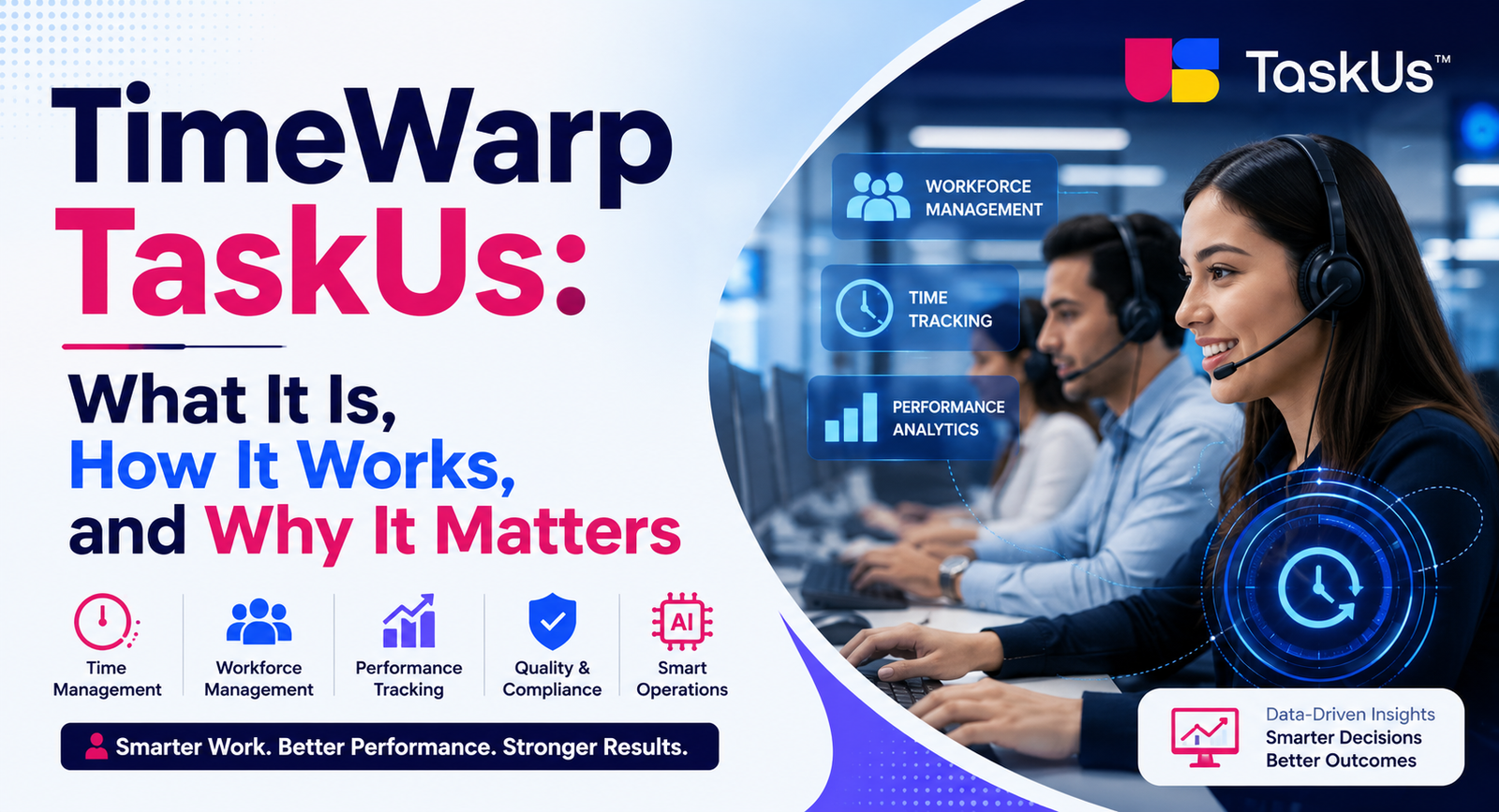
In today’s digital workplace, managing time, tasks, employee performance, and customer operations efficiently has become increasingly important. Large service organizations often depend on technology to coordinate teams, maintain quality, and keep workflows organized. This is where the term TimeWarp TaskUs comes into the picture.
People searching for TimeWarp TaskUs may encounter different explanations online. Some sources describe it as a productivity or customer-support solution, while others associate it with an internal workforce and operational system connected with TaskUs. The safest way to understand the topic is to separate confirmed information about TaskUs from assumptions about a specific internal platform.
TaskUs is a global digital services company that combines specialized human talent with technology to provide customer experience, AI, trust and safety, and other business services. Its official technology information highlights machine learning, real-time monitoring dashboards, predictive analytics, and AI-powered tools designed to improve efficiency and scale.
In this guide, we will explore what TimeWarp TaskUs generally refers to, why time and workforce management matter in large operations, how systems of this type can support employees and managers, and what you should know before looking for access or login information.

What Is TimeWarp TaskUs?
TimeWarp TaskUs is commonly associated online with an internal workforce, time-management, and operational tracking environment connected to TaskUs. Unlike a normal productivity application that anyone can download and purchase, current online descriptions generally present TimeWarp as something intended for the TaskUs work environment rather than a public software product.
The exact internal functionality of a system called TimeWarp is not fully documented on TaskUs’s public website. Therefore, it is better not to treat every feature mentioned by third-party websites as an officially confirmed feature.
At a high level, the term is connected with areas such as:
- Workforce and time management
- Employee schedules
- Attendance information
- Task and workflow tracking
- Performance monitoring
- Operational reporting
- Quality and process management
These functions make sense in a large digital-services environment because organizations need reliable ways to coordinate people, workloads, schedules, and performance.
TaskUs itself publicly emphasizes technology-enabled operations. Its technology page says the company uses machine learning algorithms, real-time monitoring dashboards, and predictive analytics to make its workforce more proactive and customer-focused.
See More About: Gaming&Entertainment
Why Time Management Matters at TaskUs
Time management becomes more complicated when thousands of employees work across different teams, projects, schedules, and locations.
For a digital services company, a small delay can affect several parts of an operation. A delayed task can influence another team’s workload, a customer response can take longer, and managers may have less visibility into overall performance.
A structured workforce system can help organizations create a clearer picture of daily operations.
For example, managers may need to understand:
- Who is scheduled to work?
- Which tasks need attention?
- How much work has been completed?
- Are teams meeting expected timelines?
- Where are workflow bottlenecks occurring?
- Which processes need improvement?
The objective is not simply to count hours. Effective workforce management connects time, people, processes, quality, and business outcomes.
How TimeWarp TaskUs Fits Into Workforce Management
A useful way to understand TimeWarp TaskUs is to look at the broader workforce-management process.
A large service organization typically needs several layers of operational visibility. Employees need information about their schedules and responsibilities, while supervisors need information about workload and performance.
A system associated with these activities can act as a central point for operational information.
1. Time and Attendance Tracking
One of the most commonly reported associations with TimeWarp is time tracking.
Time and attendance systems help organizations maintain records of working schedules and attendance. Accurate records are important for workforce planning and administrative processes.
For employees, clear time records can make schedules easier to understand. For managers, they can provide information needed to organize staffing.
However, the exact way TimeWarp handles attendance or payroll should be confirmed through TaskUs’s internal documentation rather than relying on unofficial websites.
2. Schedule Management
Large customer-service operations often require employees to work different shifts. Workforce scheduling helps ensure that the right number of people are available when demand is highest.
A digital scheduling system can make it easier to organize:
- Work shifts
- Team assignments
- Schedule changes
- Staffing requirements
- Availability information
This becomes particularly valuable when operations work across multiple regions and time zones.
3. Task and Workflow Visibility
Modern service organizations handle many tasks simultaneously. Without centralized information, it can become difficult to understand what has been completed and what still requires attention.
Workforce systems can provide visibility into workflow activity and help managers identify operational bottlenecks.
TaskUs publicly describes its approach as combining intelligent automation with specialized talent to solve complex operational challenges.
4. Performance Monitoring
Performance measurement is another important part of workforce management.
Instead of relying only on individual observations, organizations can use operational data to identify trends. This can help managers understand whether processes are working as expected.
Performance information can support:
- Coaching
- Training
- Process improvement
- Quality management
- Workforce planning
The goal should be to use data responsibly and fairly rather than treating a single metric as a complete picture of an employee’s performance.
TimeWarp TaskUs and Quality Improvement
Quality is particularly important in customer experience and digital outsourcing.
TaskUs’s public customer-experience materials emphasize process accuracy, quality assurance, customer satisfaction, and technology-enabled workflows. Its current CX offering combines AI-powered systems with human expertise to handle routine activities while allowing people to focus on more complex customer situations.
This approach shows why operational systems matter.
Imagine a customer-support process where hundreds or thousands of interactions are handled every day. Managers need more than a simple count of completed tasks. They also need to understand whether work is being completed accurately and consistently.
Historical operational information can help teams identify patterns such as:
- Repeated workflow delays
- Training requirements
- Process bottlenecks
- Quality concerns
- Staffing gaps
This creates an opportunity for continuous improvement.
The Role of AI and Automation
AI is an increasingly important part of TaskUs’s technology strategy.
TaskUs publicly states that it uses AI to automate high-volume tasks while empowering employees to focus on situations requiring human judgment. Its AI and data services also include automation, AI operations, model testing, and real-time quality monitoring.
This broader technology environment is relevant when discussing TimeWarp TaskUs, but it is important to distinguish between TaskUs’s confirmed public AI capabilities and claims about specific TimeWarp features.
AI can potentially support workforce operations by helping organizations:
- Identify patterns in operational data
- Automate repetitive activities
- Improve workflow efficiency
- Provide useful insights
- Support faster decision-making
The strongest model is usually not “AI replaces everyone.” Instead, technology handles repetitive or data-heavy activities while people handle situations requiring context, judgment, communication, and empathy.
TaskUs itself describes this human-and-technology relationship as combining people with technology to improve efficiency and scale.
Benefits of a TimeWarp-Style Workforce System
If TimeWarp is understood as part of an internal workforce-management environment, several potential benefits become clear.
Better Operational Visibility
Managers can gain a clearer view of schedules, workloads, and performance trends.
Improved Workforce Planning
Accurate operational information can help teams plan staffing according to business requirements.
Greater Accountability
Clearly defined schedules, tasks, and performance expectations can create greater accountability.
Faster Identification of Problems
When operational information is centralized, teams can identify workflow problems earlier.
More Consistent Processes
Structured systems can encourage employees and managers to follow established procedures.
Data-Informed Decisions
Instead of relying entirely on assumptions, managers can use available operational data to make better decisions.
Support for Continuous Improvement
Historical information can help organizations understand what worked, what did not, and where processes can be improved.
TimeWarp TaskUs for Employees
For employees, an internal workforce platform can be especially useful because it can bring important work information into one environment.
Depending on the systems available to a particular employee or location, this type of platform may relate to schedules, attendance, tasks, or performance information.
Employees can benefit from having clearer information about their work responsibilities.
At the same time, digital monitoring should be balanced with transparency and responsible management. Employees should understand what information is being collected, why it is collected, and how it is used.
This is important because workforce technology should support productivity without creating unnecessary confusion or excessive pressure.
TimeWarp TaskUs for Managers
Managers have different needs from employees.
A manager may need a broader operational view to understand:
- Team capacity
- Work allocation
- Schedule coverage
- Quality trends
- Performance patterns
- Training requirements
A centralized system can make these areas easier to organize.
Instead of checking multiple disconnected sources, managers can potentially use operational dashboards and reports to identify where attention is needed.
This can be especially valuable in high-volume environments where manual monitoring would consume significant time.
Is TimeWarp TaskUs a Public Software Product?
This is one of the most important questions surrounding the keyword.
Current third-party descriptions generally characterize TimeWarp as an internal TaskUs system rather than a public SaaS product.
That means someone who is not part of TaskUs should not assume that they can simply create a public account, purchase a subscription, or download an official TimeWarp application from a normal app store.
The exact access process can also vary by employee, region, role, and internal security requirements.
For this reason, anyone looking for TimeWarp access should use official TaskUs-provided instructions rather than relying on login links posted on unrelated websites.
Is TimeWarp the Same as TaskUs?
No.
TaskUs is the company. It provides digital services including customer experience, AI and data services, trust and safety, financial crime and compliance, learning, and sales services.
TimeWarp TaskUs, on the other hand, is a term commonly associated with an internal operational or workforce-management environment.
This distinction is important because many online articles incorrectly present TimeWarp as though it were a standalone public productivity application.
Understanding the difference helps users interpret search results more accurately.
Common Misunderstandings About TimeWarp TaskUs
Because information about the term is scattered across the internet, several misunderstandings can occur.
Misunderstanding 1: It Is a Public Productivity App
There is currently insufficient public evidence to describe TimeWarp as a general-purpose productivity application available to everyone.
Misunderstanding 2: Anyone Can Create an Account
If TimeWarp is an internal TaskUs system, access would normally be controlled by the organization.
Misunderstanding 3: Every Online Feature List Is Official
Third-party websites sometimes list features such as AI chatbots, automated customer responses, or specific integrations. Those claims should not automatically be treated as official TimeWarp documentation.
TaskUs does publicly describe AI-powered tools and real-time monitoring technology, but that does not mean every capability mentioned online belongs specifically to TimeWarp.
Misunderstanding 4: TimeWarp Replaces Human Workers
TaskUs’s public technology strategy emphasizes the combination of human expertise and intelligent technology. Its current CX offering describes AI as a way to automate routine work while people handle complex interactions.
Security and Access Considerations
Internal workforce platforms often contain sensitive employee and operational information. That makes security an important consideration.
Employees should avoid entering company credentials into websites that are not provided or approved by TaskUs.
A good security approach includes:
- Use official company instructions
- Keep passwords private
- Follow company authentication requirements
- Avoid sharing login credentials
- Be careful with suspicious login pages
- Contact the appropriate internal support team when access fails
If you are a TaskUs employee and cannot access an internal system, the safest option is to follow the company’s official IT or workforce-support process.
How TimeWarp Connects With the Bigger TaskUs Technology Strategy
The broader TaskUs technology strategy helps explain why systems for workforce management and operational visibility are important.
TaskUs says its technology ecosystem combines machine learning, real-time monitoring, predictive analytics, and AI tools with human expertise.
Its current services also emphasize AI-powered customer experience, automation, and human-in-the-loop processes.
This reflects a larger industry trend.
Modern outsourcing is no longer simply about assigning employees to repetitive tasks. Organizations increasingly combine:
People + Data + Automation + AI + Quality Management
The result can be a more measurable and scalable operating model.
In that broader context, TimeWarp TaskUs is best understood through the lens of workforce organization, operational visibility, and technology-supported performance management rather than as a mysterious standalone application.
What Makes TimeWarp Relevant Today?
The workplace is becoming more distributed, data-driven, and technology-focused.
Teams may work across countries and time zones. Customers expect quick responses. Businesses want consistent quality while controlling operational costs. Managers need useful information without manually checking every task.
These pressures make workforce-management technology increasingly important.
A well-designed internal system can help connect daily employee activity with broader operational goals.
The real value is not simply tracking time. The bigger objective is understanding how time, resources, processes, and technology work together to produce better outcomes.
Final Thoughts on TimeWarp TaskUs
TimeWarp TaskUs is a keyword surrounded by considerable confusion online. Some articles describe it as a productivity and customer-support platform, while other sources associate it with TaskUs’s internal workforce and operational systems. Based on the available information, it is more responsible to describe TimeWarp as an internal TaskUs-related system or operational concept rather than claiming it is a public software product.
The broader context is easier to understand. TaskUs uses technology, automation, analytics, and AI alongside human expertise to improve customer experience and operational efficiency. Its public technology materials specifically discuss real-time monitoring, predictive analytics, machine learning, automation, and AI-powered tools.
For employees and people researching the term, the most important point is that TimeWarp TaskUs should not automatically be treated as a public app that anyone can sign up for. Internal access, features, and procedures should be confirmed through official TaskUs channels.
Ultimately, the concept represents a broader shift in modern business: using technology and data to organize work more effectively while keeping human expertise at the center. That balance between automation and people is increasingly important in customer experience, outsourcing, and digital operations.
Frequently Asked Questions About TimeWarp TaskUs
What is TimeWarp TaskUs?
TimeWarp TaskUs is commonly associated with an internal TaskUs workforce and operational management environment. Public information about its exact internal features is limited, so specific capabilities should be confirmed through official TaskUs resources.
Is TimeWarp TaskUs available to everyone?
No public evidence indicates that it is a general consumer software product. Third-party sources generally describe it as an internal system associated with TaskUs operations.
Is TimeWarp TaskUs the same as TaskUs?
No. TaskUs is the company, while TimeWarp is a term associated with an internal operational or workforce-management system.
Does TimeWarp TaskUs use AI?
TaskUs publicly uses AI, automation, machine learning, and analytics across its technology and service operations. However, individual features should not automatically be attributed specifically to TimeWarp unless officially documented.
Can I download TimeWarp TaskUs?
It should not be assumed that TimeWarp is a public downloadable application. If you are a TaskUs employee, follow the company’s official instructions for accessing internal systems.
Why is TimeWarp TaskUs searched online?
People may search for the term because they want to understand TaskUs workforce systems, time management, employee scheduling, operational tracking, or access information. Search data also shows that “timewarp taskus” is a significant branded search term associated with TaskUs.
What is the main purpose of a system like TimeWarp?
The broader purpose of an internal workforce system is to help organize time, schedules, tasks, performance information, and operational workflows so teams can work more efficiently and consistently.